On this page
- AI receptionist vs. answering service: the short answer
- How each one handles a real call
- AI receptionist vs. answering service cost in 2026
- Where an AI receptionist wins
- Where a live answering service still wins
- Compliance: what to check for either option
- How to choose: a simple decision guide
- Adaptify: a done-for-you AI receptionist
- Sources
AI receptionist vs. answering service is the question most small businesses face once voicemail stops working. Both answer your phone when you can't. The difference is what happens on the call, what it costs at your volume, and what you get afterward. This guide compares them honestly, including where a human still wins.
AI receptionist vs. answering service: the short answer
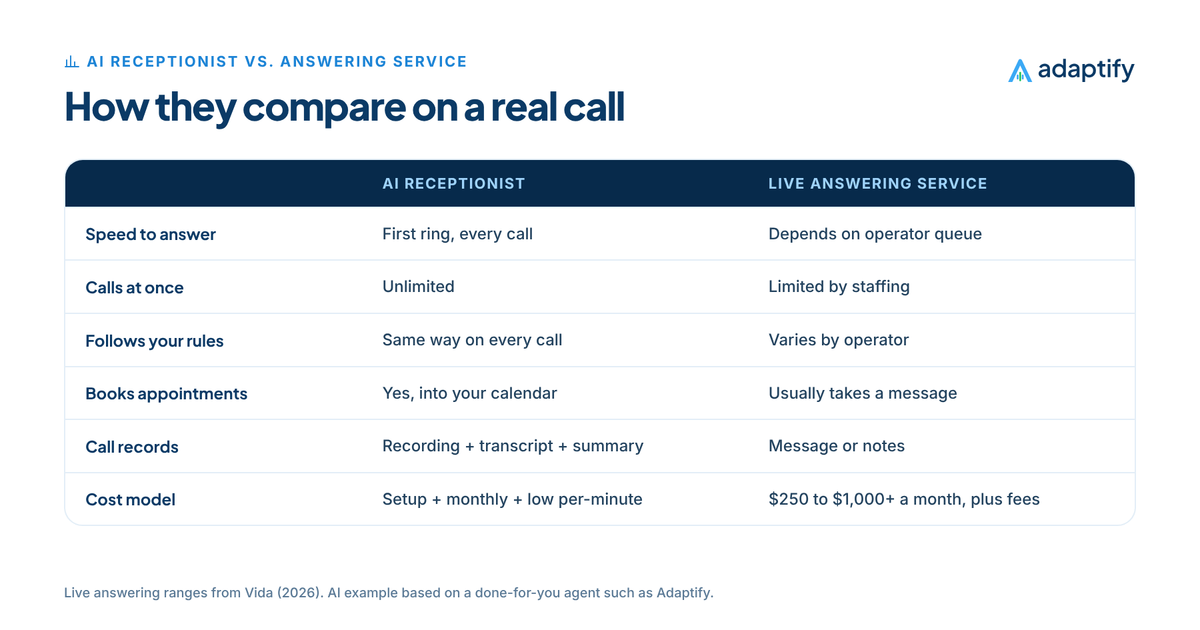
A live answering service puts a human operator on the line. They answer in your company's name, read your script and usually take a message or transfer the call. An AI receptionist is a voice agent that answers instantly, follows your rules on every call and can book appointments, transfer calls, send texts and log everything.
- Choose a live answering service if you get few calls, mostly need messages taken and want a human voice on every call.
- Choose an AI receptionist if you need every call answered instantly, emergencies sorted from routine requests, jobs booked and costs that don't jump with your busy season.
How each one handles a real call
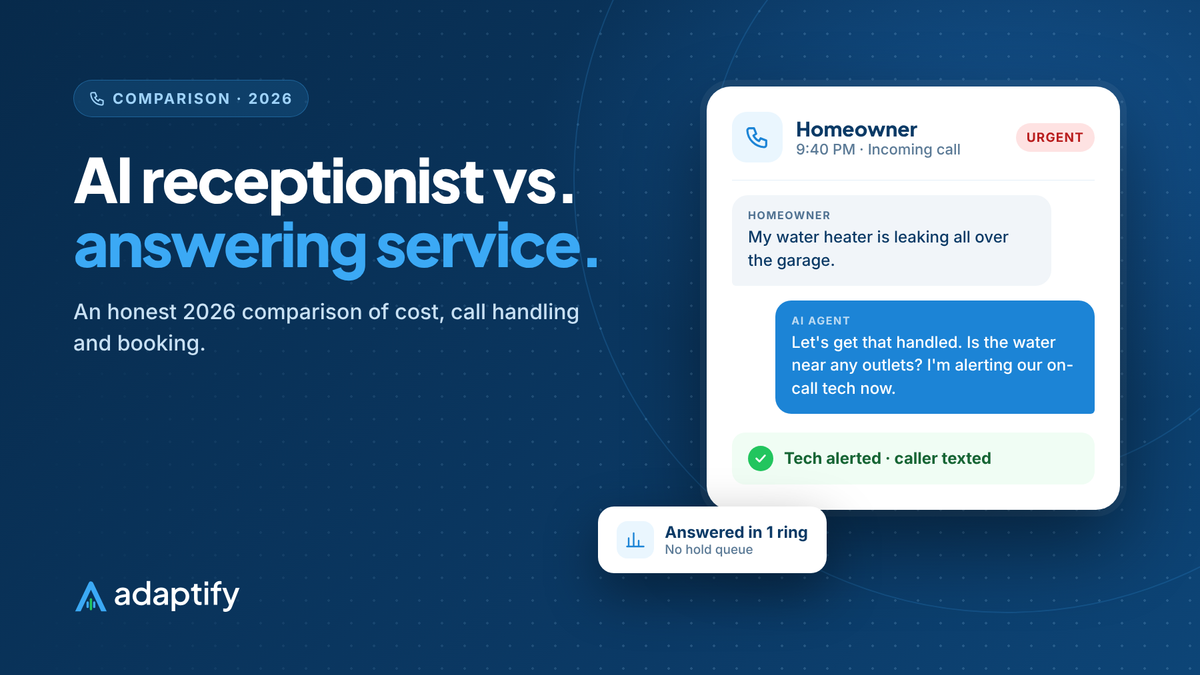
Take a common after-hours call: a homeowner at 9:40 p.m. whose water heater is leaking.
With a live answering service
The call rings into a shared call center. If operators are busy, the caller waits. An operator answers with your company name and reads your script. They take the name, number and problem, then send you a message or try to transfer the call to your on-call person. Quality depends on which operator picks up and how well they know your script. Most services do not book jobs into your calendar.
With an AI receptionist
The AI receptionist answers on the first ring, even if ten other people are calling. It asks your safety questions first, collects the address and the problem, recognizes the leak as an emergency from your rules and alerts your on-call tech by text and call. If the tech wants to talk to the caller, it transfers the call. For a routine request, it books the visit into your calendar and texts the caller a confirmation. Every call is recorded and transcribed.
That is the core trade-off. A human brings judgment and warmth. An AI brings speed, consistency and the ability to act, not just take notes.
AI receptionist vs. answering service cost in 2026
Pricing models differ, so compare at your real volume.
Live answering service pricing. A 2026 pricing guide from Vida puts live answering at $250 to $1,000+ a month, or roughly $0.65 to $1.75 a minute, or $1.75 to $4.00 per answered call. It lists extra charges for weekends (10% to 25% higher), holidays (1.5 to 2 times normal), transfers, script changes and overages, and estimates these can add 15% to 25% to the advertised price. Vida sells AI answering, so weigh that. (Vida)
AI receptionist pricing. Self-serve AI tools start around $25 to $200 a month, according to the same guide, but you build and maintain the agent yourself. Done-for-you AI receptionists cost more up front because someone builds, tests and manages the agent around your business. Adaptify, for example, charges $600 one time for setup (with 120 free minutes), $0.25 a minute for calls and $400 a month for ongoing management. See AI answering service pricing for how the models compare.
Here is how the math plays out at three volumes, illustrative only:
- 100 minutes a month: live answering at $0.65 to $1.75 a minute is about $65 to $175 before minimums and fees, so plan minimums usually decide the price. A done-for-you AI receptionist costs more here. A self-serve AI tool may cost less if you have time to build it.
- 400 minutes a month: live answering is about $260 to $700 plus fees. A done-for-you AI receptionist at $0.25 a minute plus $400 management is about $500. The costs start to meet.
- 1,500 minutes a month: live answering is about $975 to $2,625 plus fees. The same AI receptionist is about $775. The gap is now large, and it widens in your busy season.
The cost that matters most is not on either invoice. It is the jobs you lose when calls go unanswered or only become messages. Run your own numbers in the missed call calculator.
Where an AI receptionist wins
- Speed. It answers on the first ring, every time. No hold queue during storms, freezes or Monday mornings.
- Unlimited calls at once. Ten callers at 8 p.m. get ten answers.
- Consistency. It asks your questions in your order on every call. No operator who skipped the safety script.
- Action, not just messages. It can book into your calendar or field service software, transfer to your on-call person, text confirmations and escalate emergencies. See AI receptionist that books appointments.
- A full record. Every call has a recording and transcript you can review. See call recordings and transcripts.
- Costs that scale slowly. Per-minute AI rates are usually far below live operator rates.
Where a live answering service still wins
- Rare, complex or emotional calls. A grieving family, a complicated legal question or a confused older caller may need a person's judgment.
- Callers who refuse AI. Some people hang up on any automated voice. A good AI receptionist offers a transfer to a person, but a live service starts with one.
- Very low volume. If you get a handful of calls a month and only need messages, a small live plan can be cheaper.
The practical answer for many businesses is both: an AI receptionist answers everything instantly and hands the hard calls to a human, whether that is your on-call person or your team in the morning.
Compliance: what to check for either option
- AI disclosure. Utah's 2025 law requires businesses using generative AI in consumer transactions to disclose it when a consumer clearly asks, and gives a safe harbor for clear disclosure at the start of the interaction. (Utah SB 226) Telling callers they are speaking with an AI is good practice everywhere.
- Robocall rules are about outbound calls. The FCC's February 2024 ruling says AI-generated voices count as "artificial" voices under the TCPA, which governs calls you place to consumers. (FCC ruling summary) Answering calls customers place to you is a different situation, but any follow-up calls or texts you send should follow TCPA consent rules.
- Call recording consent. About a dozen states, including California, Florida, Illinois, Pennsylvania and Washington, require consent from everyone on a call before recording. A short notice at the start of the call covers this for both options.
- Health and payment data. If callers share health or card details, ask whether the provider is HIPAA and PCI DSS compliant and will sign a BAA.
How to choose: a simple decision guide
- Pull last month's call log. Count calls by hour and note what happened to the ones you missed.
- Decide what each call needs: a message, a dispatched person or a booked appointment.
- Price both options at your real minutes, including your busiest month and all fees.
- Ask each vendor to walk you through your hardest call type, then call their demo yourself.
- Start with nights and weekends if you are unsure. That is where most missed calls hide.
Industry guides go deeper on each trade: plumbing, HVAC, electricians, roofing and water damage restoration.
Adaptify: a done-for-you AI receptionist
Adaptify builds, launches and manages a custom AI receptionist for your business, so you don't touch any software. It answers every call in a natural voice, follows your rules, escalates emergencies to your on-call person, transfers live calls, books into your calendar or field service software, texts confirmations and logs every call with a recording and transcript. It is built on a voice platform that is HIPAA, SOC 2 and PCI DSS compliant, with BAAs available. Most agents go live in 6 days and you keep your number.
Learn how a done-for-you AI receptionist differs from DIY tools, see how an AI phone agent works, check pricing or request your agent.
Sources
Figures are reported by the organizations named. Vida sells AI answering, so its estimates are vendor-published.
Frequently asked questions
What is the difference between an AI receptionist and an answering service?
An answering service uses human operators who answer in your company's name, follow a script and usually take messages. An AI receptionist is software with a natural voice that answers instantly, follows your rules and can book appointments, transfer calls, send texts and log every call.
Is an AI receptionist cheaper than an answering service?
Often, but not always. At very low volume, a basic live answering plan can cost less. As minutes grow, per-minute and per-call fees from live services climb fast, while AI receptionists usually charge a lower per-minute rate. Compare your real monthly minutes, including your busiest month.
Can an AI receptionist handle emergency calls?
Yes, if it is set up with clear emergency rules. A well-built AI receptionist asks safety questions first, identifies emergencies from your list and alerts or transfers to your on-call person right away.
Do callers know they are talking to an AI?
They should. Good practice is to disclose AI use clearly, and some states require it. Utah, for example, requires businesses to disclose generative AI use when a consumer clearly asks.
Will an AI receptionist replace my front desk?
It usually covers the calls your front desk can't: after hours, overflow and busy periods. Many businesses use an AI receptionist for nights and weekends and keep staff on the phone during the day.
What should I look for in an AI receptionist?
Natural voice, your own rules and scripts, emergency escalation, calendar booking, live transfer, call recordings and transcripts, a clear AI disclosure and someone who builds and tunes it for you if you don't have time.