On this page
- Why an HVAC answering service matters after hours
- What you lose when HVAC calls go unanswered
- What a good HVAC answering service has to do
- Voicemail, staff, live operators or AI: how the options compare
- HVAC answering service cost
- Questions to ask an HVAC call answering vendor
- How to set up after-hours call answering in a week
- Adaptify: AI call answering for HVAC contractors
- Common mistakes when you outsource HVAC phone answering
- HVAC answering service checklist
- Sources
An HVAC answering service picks up your calls when the office is closed or your techs are busy. It sorts emergencies from routine requests and gets the job moving while you are off the clock. It matters because when an AC dies at 9 p.m. in July, nobody waits for the office to open. They call the next HVAC company on the list, and the first one that answers usually gets the job.
This guide compares the four real options: voicemail, an on-call rotation, a live operator and an AI phone agent. It shows what each one costs and gives you a checklist for choosing. The numbers come from published studies, and every source is linked at the end.
Why an HVAC answering service matters after hours
In HVAC, "after hours" is not an edge case. That makes phone answering a core tool, not an extra. Comfort problems peak in the evening, when people get home and notice the house is too hot or too cold.
ServiceTitan studied inbound calls to residential HVAC shops across 2025 (its customers, not a nationally representative sample). Calls outside business hours, which it defines as weekdays before 8 a.m. and after 5 p.m. plus all weekend hours, made up 14.1% of call volume in June and dipped to 9.8% in October. Weekend calls climbed from 2.95% of volume in October to 4.9% at the August peak. The busiest window of the day was 5 p.m. to 9 p.m., which is exactly when most small shops have gone home. (ServiceTitan, State of the Trades)
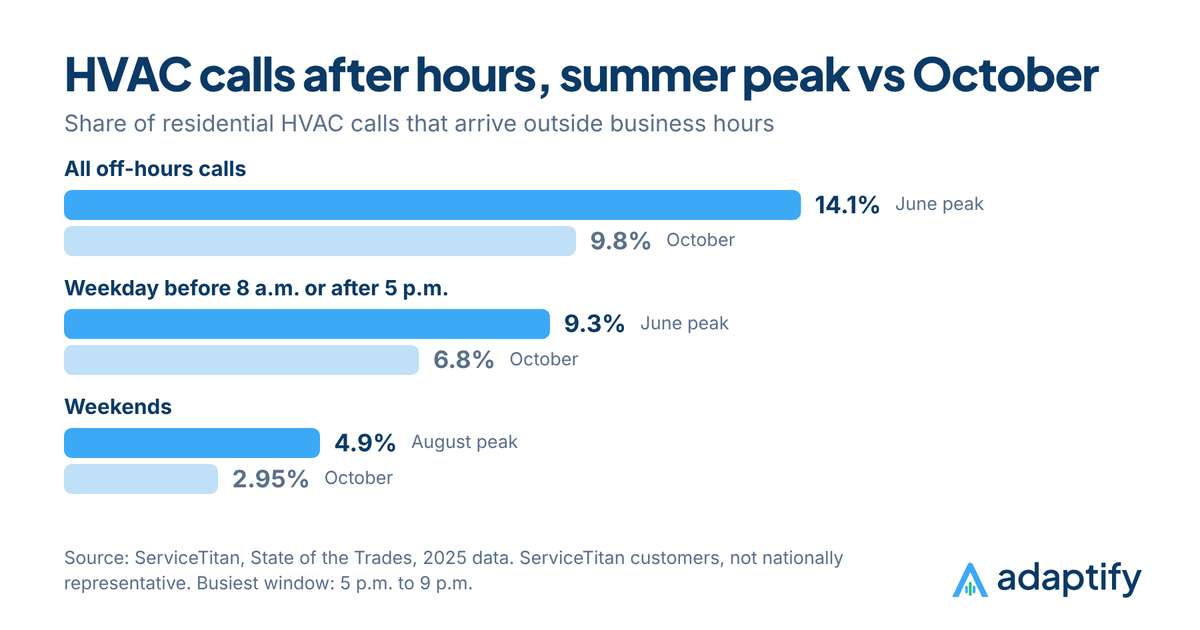
Those are shares of all calls. Summer volume is higher overall, so the number of after-hours calls in July is bigger than the percentage suggests.
Urgency also differs from other trades. A dead AC in a heat wave is a comfort problem for most households and a health risk for some. The CDC notes that adults aged 65 and older are more prone to heat-related illness. It also warns that a fan should not be your main cooling source in extreme heat. (CDC) Those callers do not wait for a callback tomorrow.
What you lose when HVAC calls go unanswered
Most missed calls do not turn into voicemails. They turn into calls to your competitors.
- 27% of calls to home services businesses go unanswered (Invoca, 2024).
- Fewer than 3% of callers who are pushed to voicemail leave a message (Invoca platform data). (Invoca)
- 52% of inbound calls to home services businesses reached a person in Invoca's 2026 benchmark, which covers HVAC, plumbing, restoration and other trades. The range across trades was 32% to 74%. (Invoca 2026 report)
Speed matters as much as answering. Jobber's 2026 survey of 1,050 home service owners found that 28% of customers expect an immediate reply. Another 28% expect one within an hour. Only 20% of pros replied that fast. (Jobber) After hours, the gap is wider, because the reply often waits until morning.
Here is what that looks like in practice. A homeowner calls three HVAC companies at 8 p.m. Two go to voicemail. The third picks up, asks the right questions and says a tech will call within 15 minutes. The other two never get a chance, because the homeowner never leaves a message.
What a good HVAC answering service has to do
An HVAC answering service that only takes messages solves half the problem. For HVAC, the call needs a clear path from "my system is down" to "a tech has the job." Look for these abilities:
- Triage by urgency. A no-cool call in a heat wave is not a spring tune-up request. A no-heat call in freezing weather is not either. They need different handling.
- Safety scripts. If a caller smells gas or hears a carbon monoxide alarm, the right answer is to leave the house and call 911 or the gas utility. They should not wait for a tech. A service should say that first, then log the call.
- Complete intake. Name, phone number, service address, equipment type, symptoms and how long it has been happening, so your tech arrives prepared.
- Instant alerts. The on-call tech gets a text or call with the details, and a backup person is alerted if they do not respond.
- Booking. For non-emergencies, the service books a visit, a tune-up or a replacement-quote callback so the customer is not left waiting.
- A record. Every call is logged with a summary or recording so you can follow up and see patterns.
Use this simple triage as a starting point and adjust it to your market:
- Safety — Example: Gas smell, carbon monoxide alarm — What should happen: Leave the home, call 911 or the gas utility, then alert your team
- Emergency — Example: No cool in extreme heat, no heat in freezing weather — What should happen: Alert the on-call tech now, confirm arrival window
- Urgent — Example: System runs but is failing, water leaking from the unit — What should happen: Book the earliest slot, alert the on-call tech if it worsens
- Routine — Example: Tune-up, noise, replacement quote — What should happen: Book a visit or callback next business day
Voicemail, staff, live operators or AI: how the options compare
1. Voicemail
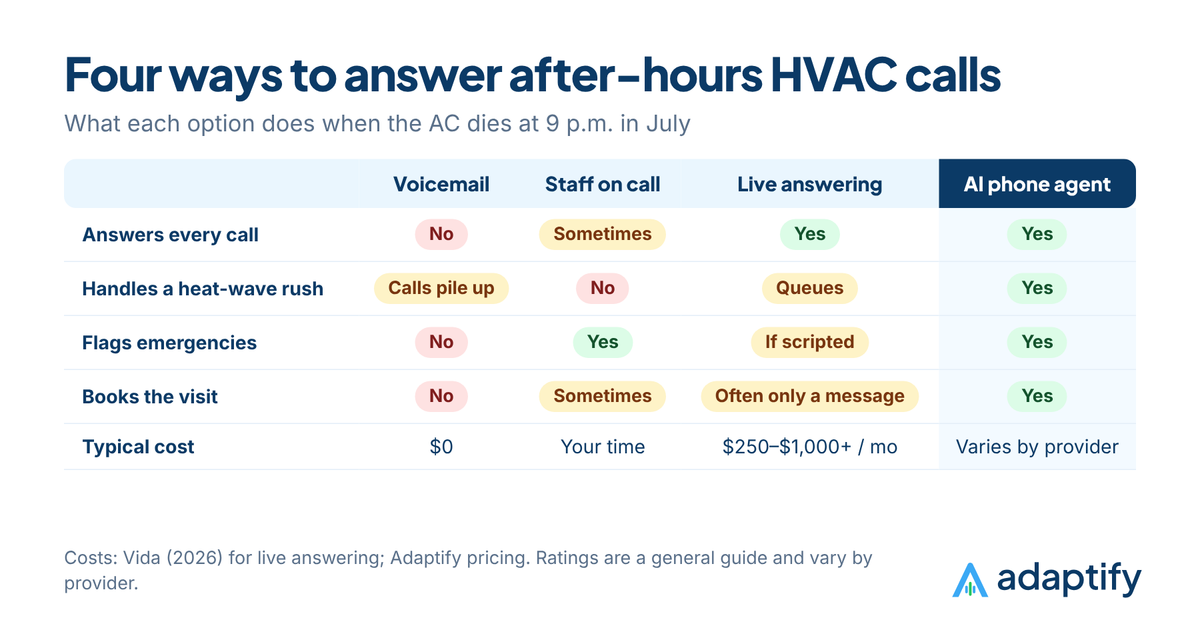
It costs nothing and catches almost nobody. With fewer than 3% of callers leaving a message, voicemail is a record of the calls you lost, not a plan. It can work as a fallback for non-urgent calls, but it should not be your emergency path.
2. An on-call rotation (you or your techs)
Many owners answer after-hours calls themselves or rotate the phone between technicians. It gives you control and costs only your time, but it is hard to sustain. Calls interrupt dinner and sleep, and techs burn out. The call still goes to voicemail when the person on call is under a house or on another call. In peak summer weeks it breaks first, which is exactly when call volume is highest.
3. A live answering service
A human operator answers on your behalf, reads from a script and sends you the message or transfers the call. It is a solid option when you mainly need a friendly voice and a message, and it scales to many calls without hiring.
Typical costs, according to a 2026 pricing guide from Vida (a vendor that sells AI, so read with that in mind): $250 to $1,000+ a month, or roughly $0.65 to $1.75 a minute, or $1.75 to $4.00 per answered call. Watch for extras: weekend rates 10% to 25% higher, holiday rates 1.5 to 2 times normal, transfer fees, script-change fees and overage charges. The same guide estimates hidden charges can add 15% to 25% to advertised prices. (Vida)
The trade-off: many live services take messages instead of booking jobs. Each caller also waits while the operator works through a script they do not know well. Summer volume also means summer bills.
4. An AI phone agent
An AI phone agent answers instantly and follows your rules. It can handle many calls at once, so there is no queue on the hottest day of the year. It can ask the right HVAC questions, flag emergencies, alert your on-call tech and book routine visits.
Basic AI answering tools are priced from about $25 to $200 a month, according to the same Vida guide. Done-for-you agents cost more, because someone builds and manages the agent around your business. The trade-off is that an AI agent is only as good as its setup. Look for one that is tested on your real call types, hands off to a human easily and tells callers it is an AI.
HVAC answering service cost
What you pay for HVAC call answering depends on call volume. Here is a simple example, clearly illustrative:
- Volume: 100 after-hours calls a month, averaging 3 minutes each (300 minutes).
- Live answering at $1.75 to $4.00 per call: about $175 to $400 a month, before extra fees and plan minimums.
- AI phone agent: pricing varies by provider. Most combine a setup fee, a monthly fee and a per-minute rate, so ask for all three and multiply by your real minutes.
At low volume, a basic live service can cost less than a done-for-you AI agent. The math tips the other way when volume rises. It also tips when you want emergencies flagged and jobs booked, not just messages passed along. A heat wave that doubles your calls doubles a per-call bill. An AI agent with a flat monthly fee and a low per-minute rate grows far more slowly.
Compare that with the cost of a lost job. HomeServe's 2026 cost guide puts typical AC repair at $250 to $700, with an average near $375. It says emergency AC repairs run about $150 to $300 an hour. (HomeServe) One saved repair can cover a month of service. A saved system replacement covers the year.
Questions to ask an HVAC call answering vendor
Whichever vendor you choose, ask every vendor the same questions:
- What exactly happens when a caller says they have no cooling in a heat wave? Walk me through the script.
- How do you handle a gas smell or carbon monoxide alarm?
- Who gets alerted, by what method, and what happens if they do not answer?
- Can you book into my calendar or software, or do you only take messages?
- Do I get call summaries or recordings, and where?
- What does a busy weekend cost? List every fee.
- What is the contract length, and what is the cancellation policy?
- Can I change the script or rules, and what does that cost?
- How are callers told they are speaking with an AI or an outsourced operator?
Ask for a test call to your own number. A five-minute call tells you more than any brochure.
How to set up after-hours call answering in a week
- Define after hours. Pick the hours your office stops answering, including weekends and holidays.
- Write your emergency list. Decide which calls justify waking your on-call tech and which wait for morning.
- Choose the on-call contact and a backup. Include phone numbers and a response time.
- List what you want asked. Use the intake list above and add anything specific to your equipment.
- Set your booking rules. Which services can be booked after hours, and in which windows?
- Forward your calls. Most answering options work by forwarding your business line when you are closed or busy.
- Test it. Call at different times, as a customer with a real problem.
- Review weekly. Read the call summaries for the first month and adjust.
Adaptify: AI call answering for HVAC contractors
Adaptify builds, launches and manages an AI phone agent for your HVAC company, so you do not configure anything yourself. The agent answers no-heat and no-cool calls, alerts your on-call technician, books service calls, tune-ups and replacement quote callbacks, and logs every call. It goes live in 6 days.
Want to see how this would work for your company? Check out the Adaptify HVAC page and the pricing page, or request your agent.
It is not the right fit for everyone. If you take a handful of after-hours calls a month and only need messages, a basic live service may cost less. If you lose real jobs to unanswered evening calls, an AI phone agent is built for that. It answers, sorts and books each one.
Common mistakes when you outsource HVAC phone answering
- Treating voicemail as a plan. Fewer than 3% of callers leave a message.
- Skipping the safety script. Gas and carbon monoxide calls need a different response than a warm house.
- Choosing on price alone. A cheap service that only takes messages can cost you more in lost jobs.
- Ignoring summer volume. Check what your bill looks like in your busiest month, not your slowest.
- Never calling your own number. Test it every month.
HVAC answering service checklist
- Count how many calls you missed last month and what time they came in.
- Multiply by your average ticket and your booking rate to see what the gap costs.
- Decide what must reach a human immediately and what can wait.
- Pick the option that matches: message, dispatch or booked job.
- Run a test call before you commit.
Sources
Figures are reported by the organizations named. Several publishers also sell call-answering or call-tracking products, so we note vendor sources and do not treat their estimates as independent measurements.
- ServiceTitan, State of the Trades: HVAC after-hours call spike (2025 data; ServiceTitan customers, not nationally representative)
- Invoca, How much missed sales calls cost home services businesses (2024)
- Invoca, Home Services Lead Conversion Benchmarks Report 2026 (July 2026)
- Jobber, 2026 Home Service Trends Report (1,050 owners surveyed December 2025, margin of error plus or minus 3 points)
- Vida, Answering service pricing (February 2026; vendor-published ranges)
- HomeServe, HVAC repair and maintenance cost guide (March 2026)
- CDC, Heat and older adults
Frequently asked questions
What is an HVAC answering service?
It answers your business calls when you cannot, usually nights, weekends and busy periods. It collects the caller's details, sorts emergencies from routine requests and alerts your on-call technician. Some also book the visit.
How much does an HVAC answering service cost?
An HVAC answering service typically costs $250 to $1,000+ a month for a live operator, or about $0.65 to $1.75 a minute (Vida, 2026). Basic AI answering tools run about $25 to $200 a month.
Is AI phone answering better than a live operator for HVAC?
It depends on your calls. A live operator is fine if you only need a message taken. An AI phone agent suits you when you want every call answered instantly, emergencies flagged and jobs booked, without per-call charges that climb in summer.
What questions should the person answering ask an HVAC caller?
At minimum: name, phone number, service address, what is wrong (no cool, no heat, noise, leak), how long it has been happening, and whether anyone at home is vulnerable, such as an infant or older adult. A gas smell or carbon monoxide alarm should trigger a safety script and a 911 or gas-utility call.
Do I need an HVAC answering service if I already have voicemail?
Voicemail is not a substitute for live call answering because it catches very few callers. Invoca reports that fewer than 3% of callers pushed to voicemail leave a message, and most of the rest call the next company.
How long does HVAC call answering take to set up?
A live operator service can start in a day or two. A done-for-you AI agent takes longer because it is built around your services and rules. Many providers launch a done-for-you agent within about a week.
Can an answering service for HVAC contractors dispatch my technician?
Yes, if you give it rules. Decide who gets alerted for an emergency, how they are contacted (call, text or both), and what happens if they do not respond in a set time.