On this page
- Why plumbing calls can't wait until morning
- What one missed emergency call costs a plumber
- Plumbing emergency triage: what should happen on each call
- Voicemail, on-call, live operators or AI: how the options compare
- Plumbing answering service cost: a worked example
- Questions to ask any plumbing answering vendor
- How to set up after-hours plumbing call answering
- Adaptify: AI call answering for plumbing companies
- Common mistakes plumbers make with after-hours calls
- Plumbing answering service checklist
- Sources
A plumbing answering service answers your phone when the office is closed or every plumber is under a sink. It sorts real emergencies from routine requests and gets the job moving while you are off the clock. For plumbers, after hours is often when the most valuable calls come in. A pipe bursts at 11 p.m., a basement floods on a Sunday, a sewer line backs up the night before a holiday. The homeowner calls until someone answers, and that company usually gets the job.
This guide compares the four real options: voicemail, an on-call rotation, a live answering service and an AI phone agent. It covers what each one costs, the triage rules every plumbing call needs and a checklist for choosing. Sources are linked at the end.
Why plumbing calls can't wait until morning
Water damage gets worse by the hour. A homeowner with water coming through the ceiling is not comparing reviews. They are calling down a list, and the first plumber who answers and sounds like they know what to do wins the call.
That makes plumbing different from a lot of local businesses. A missed call to a dentist is usually a lost appointment. A missed emergency call to a plumber is a lost high-ticket job, and often a lost customer for the next ten years of water heaters and drain cleanings.
The numbers show how often that happens:
- 52% of inbound calls to home services businesses reached a person in Invoca's 2026 benchmark. Answer rates ranged from 32% to 74% across trades. (Invoca 2026 report)
- Fewer than 3% of callers pushed to voicemail leave a message, according to Invoca platform data. (Invoca)
- 28% of homeowners expect an immediate reply and another 28% expect one within an hour, but only 20% of home service pros reply that fast. (Jobber 2026 Home Service Trends Report)
After hours, the gap is wider, because the reply often waits until the office opens.
What one missed emergency call costs a plumber
Emergency plumbing is priced higher than daytime work, which makes each missed call more expensive.
- HomeAdvisor's 2026 cost guide puts typical emergency plumbing call-out fees at $100 to $300. It says the average burst pipe repair is about $500, with most jobs between $200 and $3,000. (HomeAdvisor)
- Many plumbers charge 1.5 to 3 times their normal rate for after-hours work, according to a 2026 consumer cost guide that cites Angi data. (LendEDU)
Then add what comes after the emergency. A homeowner who had a good experience at midnight calls you back for the water heater replacement, the repipe quote and the yearly drain cleaning. You can estimate your own gap with the missed call calculator, and our guide to the cost of missed calls breaks down the wider data.
Plumbing emergency triage: what should happen on each call
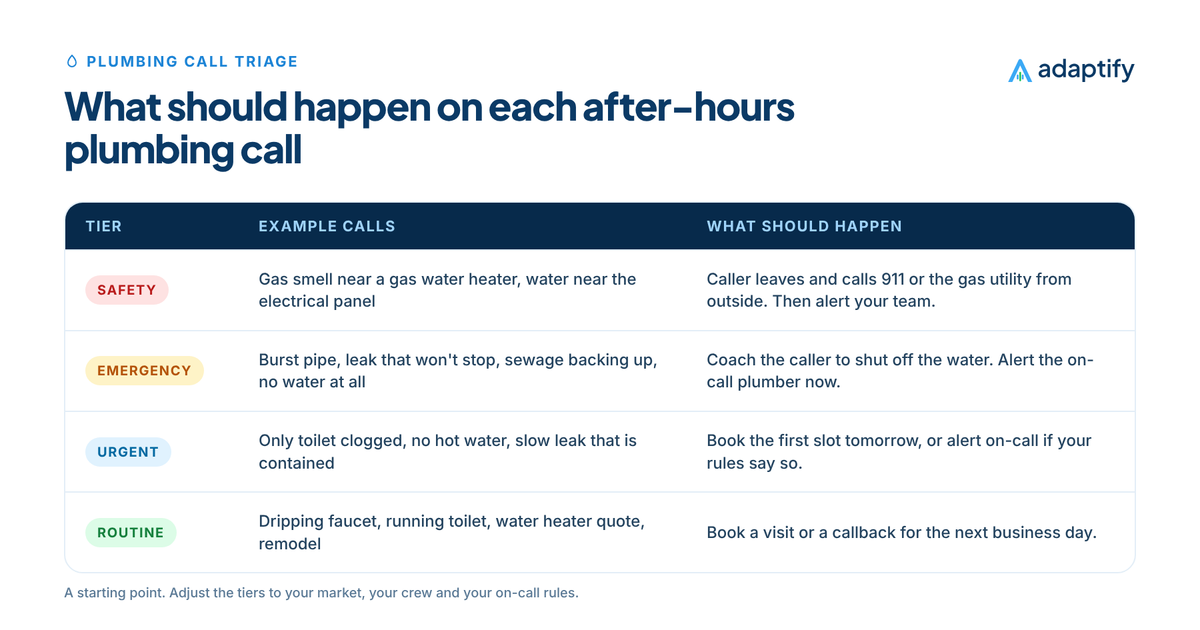
The hardest part of after-hours plumbing calls is not answering. It is deciding what happens next. Write these rules down before you pick any answering option, because every option needs them. Use this as a starting point and adjust it to your market and your crew:
- Safety — Example: Gas smell near a gas water heater, water near the electrical panel, sparking outlets — What should happen: Tell the caller to leave the area and call 911 or the gas utility from outside, then alert your team
- Emergency — Example: Burst pipe, a leak that won't stop, sewage backing up into the home, no water at all, water heater pouring water — What should happen: Coach the caller to shut off the water, alert the on-call plumber now, confirm a callback time
- Urgent — Example: The only toilet is clogged, no hot water, a slow leak that is contained — What should happen: Book the first slot tomorrow, or alert on-call if your rules say so
- Routine — Example: Dripping faucet, running toilet, water heater replacement quote, remodel work — What should happen: Book a visit or a callback for the next business day
Two details separate a good plumbing call from an average one.
1. Coach the caller while help is on the way
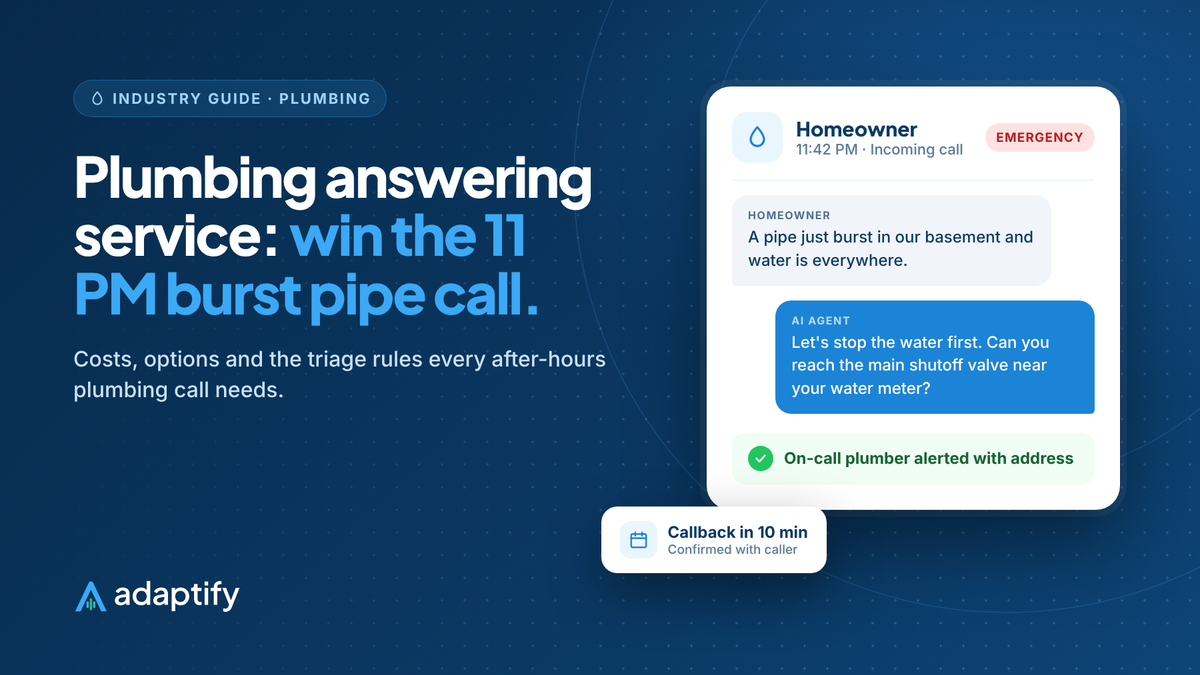
When water is running, the most useful thing anyone can say is how to stop it. A good script tells the caller to shut off the main water valve if they can do it safely. It is usually where the supply line enters the home, near the water meter, in a basement, crawlspace or utility room. If water is near outlets or appliances, they should turn off power to that area at the breaker. For a single fixture, the shutoff under the sink or behind the toilet is often enough.
That one minute of coaching limits the damage, lowers the stress in the caller's voice and shows them you know what you are doing. It also makes the caller far less likely to keep dialing other plumbers.
2. Handle gas and electrical risk first
If a caller smells gas, the answer is never "a plumber will call you back." Utilities give the same advice: leave the home right away, don't touch light switches or appliances, and call 911 or the gas company's emergency line from outside. (National Grid) Your answering option should say that first, then log the call and alert your team.
Voicemail, on-call, live operators or AI: how the options compare
1. Voicemail
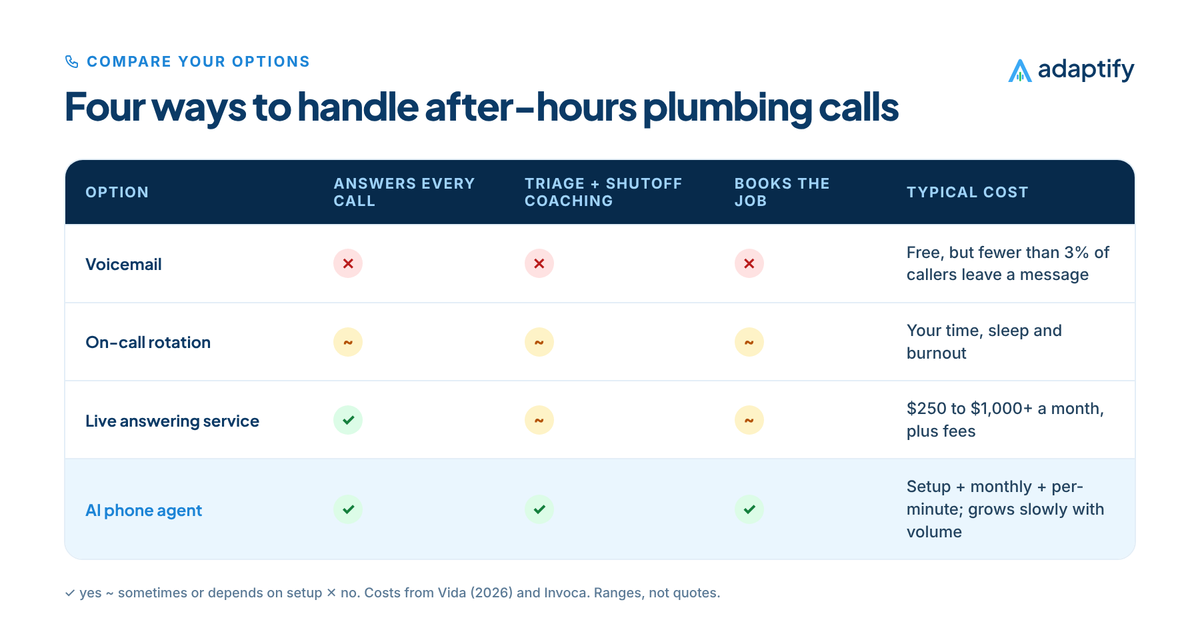
It is free and it catches almost no one. With fewer than 3% of callers leaving a message, voicemail is a list of jobs that went to someone else. Keep it as a last fallback for routine calls, never as your emergency plan.
2. An on-call rotation
Many shops forward the business line to the owner or rotate it between plumbers. You keep full control and it costs only your time. The problem is that the person on call is often the person doing the job. They are under a house, driving or already on another emergency, so the call still goes to voicemail. During a hard freeze, when dozens of calls arrive in a few hours, one phone can't keep up. Rotations also wear people out, which makes them hard to keep going.
3. A live answering service
A human operator answers in your company's name, follows a script and sends you the message or transfers the call. It is a fair choice when you mainly need a friendly voice and a message, and it scales without hiring.
A 2026 pricing guide from Vida puts live answering at $250 to $1,000+ a month, roughly $0.65 to $1.75 a minute or $1.75 to $4.00 per answered call. It also lists extras: weekend rates 10% to 25% higher, holiday rates 1.5 to 2 times normal, and transfer, script-change and overage fees that can add 15% to 25% to the advertised price. Vida sells AI answering, so read its numbers with that in mind. (Vida)
The trade-off for plumbers: many live services take messages instead of booking jobs. Operators handle calls for many industries, so they may not know a pressure-reducing valve from a P-trap. And a freeze event that triples your calls also triples a per-call bill.
4. An AI phone agent
An AI phone agent answers on the first ring, at any hour, and can take many calls at once, so there is no hold queue the night the temperature drops. It follows your triage rules on every call. It can coach the caller to shut off the water, collect the address and the problem, alert your on-call plumber and book routine work into the next day.
Basic AI answering tools start around $25 to $200 a month, according to the same Vida guide. Done-for-you agents cost more, because someone builds, tests and manages the agent around your business. The catch is that an AI agent is only as good as its setup. Look for one that has been tested on real plumbing calls, hands off to a person easily and tells callers it is an AI.
Plumbing answering service cost: a worked example
Here is a simple, illustrative example. Your numbers will differ.
- Volume: 80 after-hours calls a month, averaging 3 minutes each (240 minutes).
- Live answering at $1.75 to $4.00 per call: about $140 to $320 a month, before weekend, holiday and overage fees.
- AI phone agent: most combine a setup fee, a monthly fee and a per-minute rate. Ask for all three and multiply by your real minutes, including your busiest month.
At low volume, a basic message-taking service can cost less than a done-for-you AI agent. The math changes when volume rises, when calls arrive in bursts during freezes and storms, and when you want jobs booked instead of messages passed along. Compare any monthly bill with one burst pipe job at $200 to $3,000. Saving one emergency a month usually covers it.
Questions to ask any plumbing answering vendor
- What exactly happens when a caller says water is coming through the ceiling? Walk me through the script.
- Do you tell callers how to shut off their water? Who wrote those instructions?
- How do you handle a gas smell or water near electrical?
- Who gets alerted, by text or call, and what happens if my on-call plumber doesn't respond in 10 minutes?
- Can you book into my calendar or field service software, or do you only take messages?
- Do I get recordings or call summaries, and where?
- What does a freeze weekend with triple the calls cost me? List every fee.
- How do callers find out they are talking to an AI or an outsourced operator?
- What is the contract length, and how do I cancel?
Then call your own number at 11 p.m. with a fake burst pipe. Five minutes on the phone tells you more than any sales deck.
How to set up after-hours plumbing call answering
- Define your hours. List exactly when the office stops answering, including weekends and holidays.
- Write your triage rules. Use the table above and decide which calls wake someone up.
- Name the on-call plumber and a backup. Include phone numbers and the response time you expect.
- Write the caller coaching. Shutoff valve, breaker and gas instructions, in plain words.
- Set booking rules. Which jobs can be booked after hours, in which windows, and what you quote (or don't) on the phone.
- Forward your line. Most options work by forwarding your business number after hours or when nobody picks up, so you can keep your number.
- Test every path. Call as a homeowner with a burst pipe, a clogged toilet and a quote request.
- Review calls weekly for the first month. Tighten the script wherever a call went sideways.
Adaptify: AI call answering for plumbing companies
Adaptify builds, launches and manages an AI phone agent for your plumbing company, so there is nothing for you to set up. The agent answers every after-hours call, coaches callers to shut off the water, alerts your on-call plumber about emergencies, books routine work and logs every call with a recording and transcript. It goes live in 6 days, and you can keep your existing number.
See the industries page, check pricing, or request your agent.
It isn't the right fit for every shop. If you get a few after-hours calls a month and only need messages, a basic live service may cost less. If you lose real jobs to calls nobody answers, an AI agent is built for that.
Common mistakes plumbers make with after-hours calls
- Treating voicemail as a plan. Fewer than 3% of callers leave a message.
- Putting the on-call plumber on the phone and the job at the same time. One of them gets dropped.
- No shutoff coaching. The caller waits, the water keeps running and the job gets bigger and angrier.
- Skipping the safety script. Gas and electrical calls need a different first answer.
- Choosing on the monthly price alone. A cheap service that loses one emergency job a month is not cheap.
- Never testing. Call your own number every month, at night.
Plumbing answering service checklist
- Pull last month's missed calls and note what time they came in.
- Multiply by your average emergency ticket and your booking rate to see what the gap costs.
- Write your safety, emergency, urgent and routine rules.
- Pick the option that delivers what you need: a message, a dispatched plumber or a booked job.
- Run a test call at night before you sign anything.
Sources
Figures are reported by the organizations named. Several publishers sell call-answering or call-tracking products, so we note vendor sources and don't treat their estimates as independent measurements.
- Invoca, Home Services Lead Conversion Benchmarks Report 2026 (July 2026)
- Invoca, How much missed sales calls cost home services businesses (2024)
- Jobber, 2026 Home Service Trends Report (1,050 owners surveyed December 2025)
- HomeAdvisor, Burst pipe repair cost (2026)
- LendEDU, Emergency plumber cost (2026, citing Angi data)
- Vida, Answering service pricing (February 2026; vendor-published ranges)
- National Grid, Report a gas emergency
Frequently asked questions
What is a plumbing answering service?
It answers your business calls when you can't, usually nights, weekends and while your plumbers are on jobs. It takes the caller's details, sorts emergencies from routine work and alerts your on-call plumber. Some services also book the visit.
How much does a plumbing answering service cost?
Live operator services typically run $250 to $1,000+ a month, or about $0.65 to $1.75 a minute, before extra fees (Vida, 2026). AI phone agents range from basic tools at $25 to $200 a month to done-for-you agents with a setup fee, a monthly fee and per-minute pricing.
What counts as a plumbing emergency after hours?
Most plumbers treat these as emergencies: a burst or leaking pipe that can't be stopped, sewage backing up into the home, no water at all, a heavily leaking water heater and water near electrical panels or outlets. A gas smell near a gas water heater is a safety call: the caller should leave and call 911 or the gas utility first.
What should an answering service tell a caller with a burst pipe?
It should tell them to shut off the main water valve if they can do it safely, and to turn off power to the area if water is near outlets or appliances. Then it should take the address and alert the on-call plumber right away.
Is an AI answering service good enough for plumbers?
It can be, if it is set up around your rules and tested on real plumbing calls. AI answers instantly, handles many calls at once during freeze events and storms, and follows the same triage every time. It should hand off to a person easily and tell callers it is an AI.
Do I need an answering service if I already have voicemail?
Voicemail catches very few callers. Invoca reports that fewer than 3% of callers sent to voicemail leave a message. Someone with water on the floor calls the next plumber instead.
Can a plumbing answering service dispatch my on-call plumber?
Yes, if you give it clear rules: who is on call, how they are contacted, how fast they must respond and who is next if they don't. The service should send the address, the problem and the callback number in one message.