On this page
- Why the after-hours maintenance line matters
- Write your emergency policy first
- Four ways to run your after-hours maintenance line
- What an after-hours line costs: a worked example
- Questions to ask any property management answering vendor
- How to set up an after-hours maintenance line
- Adaptify: AI answering for property managers
- Common mistakes property managers make after hours
- Property management after-hours checklist
- Sources
A property management answering service covers your phones when the office is closed. It decides which tenant calls are true emergencies, gets your on-call maintenance tech or vendor moving and logs everything else for the morning. For property managers, after-hours calls are not about winning a new job. They are about stopping damage to the building and keeping residents who would otherwise not renew.
This guide covers the four ways to run an after-hours maintenance line, an emergency policy you can adapt, what each option costs and a checklist for choosing. Sources are linked at the end.
Why the after-hours maintenance line matters
Maintenance problems don't keep office hours. Pipes burst overnight, heat fails on the coldest weekend and toilets overflow at 2 a.m. When a resident calls, two things are at stake.
The first is the building. Water keeps running until someone turns it off. An hour of delay on a leak above a ceiling can mean drywall, flooring and the unit below. Every minute between the call and the shutoff valve costs you money.
The second is the resident. Maintenance experience is one of the main reasons people renew or leave. HappyCo, a property operations software company, surveyed 299 multifamily residents across North America for its December 2025 study "Beyond the Bot":
- 82% prefer to reach a human first when an urgent maintenance issue comes up.
- Comfort with AI drops as the stakes rise: 67% are comfortable using AI for general questions, 53% for routine maintenance and only 30% for reporting emergencies.
- Even among residents who had already used chatbots or voice agents for maintenance, 74% still preferred a human first in emergencies.
- Residents with access to human support were 11 percentage points more likely to renew than those at properties where AI was the main channel. (HappyCo)
That last finding matters for how you set up your line, and we come back to it below.
Write your emergency policy first
Every option, from your own cell phone to an AI agent, needs a written list of what counts as an emergency. Put it in the lease, the resident portal and the greeting on your line. Then the person or system answering can apply it the same way every time. Here is a starting point:
- Life safety — Example: Fire, smoke, gas smell, carbon monoxide alarm, electrical sparks — What should happen: Tell the resident to leave and call 911 or the gas utility first. Then alert the on-call manager
- Emergency — Example: Active flooding or a major leak, sewage backup, no heat in cold weather, no water, no power to the unit, a broken exterior door or lock — What should happen: Coach the resident on the shutoff if safe, dispatch the on-call tech now, confirm an arrival window
- Urgent — Example: One toilet clogged (with another working), no hot water, AC out in mild weather, a fridge not cooling — What should happen: Create a work order for first thing next business day, or dispatch if your policy says so
- Routine — Example: Dripping faucet, appliance noise, pest sighting, a burned-out light — What should happen: Log a work order and tell the resident when to expect contact
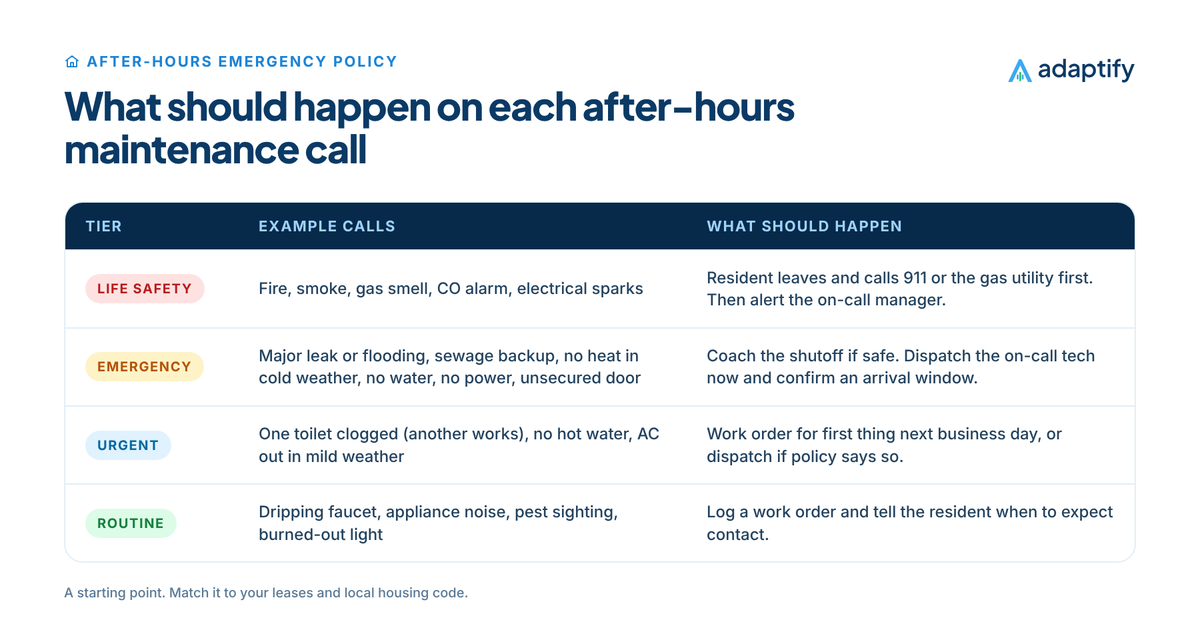
Check your local housing code for heat and essential-service requirements, since many cities set minimum indoor temperatures and response expectations. Your policy should match them.
Lockouts and identity checks
Lockouts are the most common gray area. Decide in advance: do you send someone, charge a fee, refer to a locksmith or wait until morning? Whatever the answer, the person or system on the phone must verify that the caller is a resident on the lease before anyone opens a door. Name, unit, and a detail from your records (like the phone number on file) is the minimum.
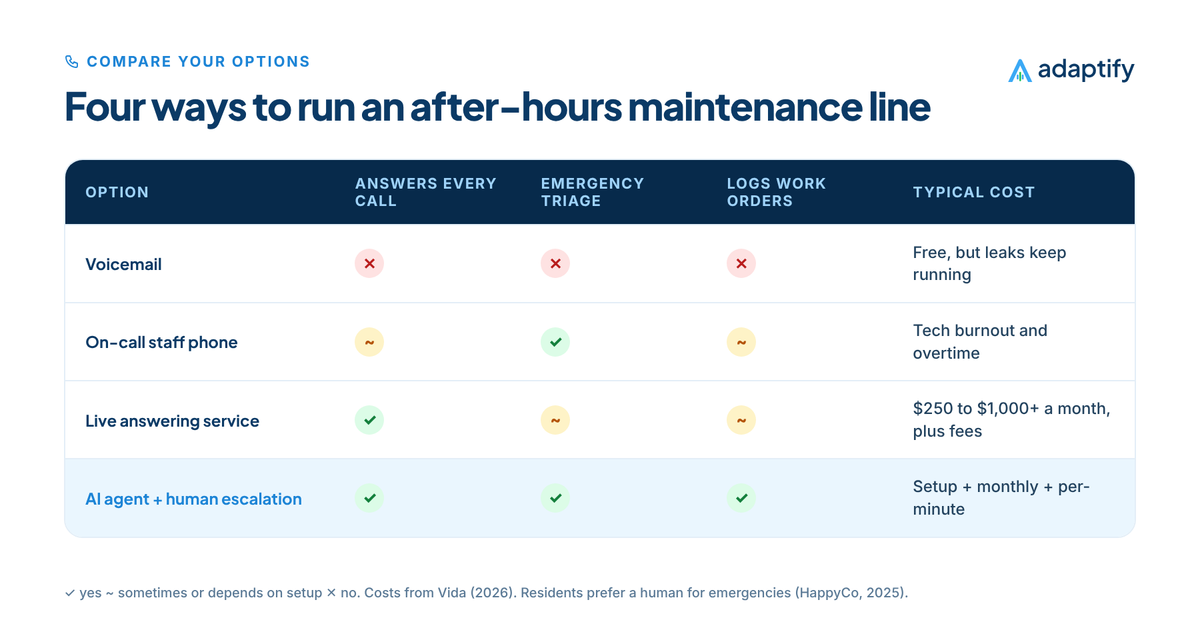
Four ways to run your after-hours maintenance line
1. Voicemail
Free and risky. A resident with water coming through the ceiling won't wait for a callback. They call again and again, then email, then post a review. Meanwhile the leak keeps going. Voicemail can't triage, can't coach a shutoff and can't dispatch.
2. On-call staff or a maintenance phone
Many managers rotate a maintenance cell phone among techs or answer themselves. You get people who know the buildings. But the on-call tech is answering every call, including routine ones, at 2 a.m. That burns people out fast, and calls go to voicemail when the tech is already on a job.
3. A live answering service
Operators answer in your company's name, follow your emergency list and dispatch or take a message. Many property managers use a live answering service for their after-hours maintenance line. It works best when your emergency list is very clear, because operators handle calls for many businesses.
Vida's 2026 pricing guide puts live answering at $250 to $1,000+ a month, or about $0.65 to $1.75 a minute, with extra fees for weekends, holidays, transfers and overages. Vida sells AI answering, so weigh that. (Vida)
The trade-offs are cost at scale, inconsistent triage across operators and work orders that still need to be typed into your system by someone.
4. An AI phone agent with human escalation
An AI phone agent for property management answers every call instantly, even when 20 residents call during a storm. It applies your emergency list the same way every time, coaches residents to shut off water when safe, verifies identity on lockouts and logs routine requests with all the details.
Given what residents told HappyCo, the best setup is AI as the front door, not the whole house. The agent answers right away and triages. For true emergencies, it connects the resident to your on-call person or confirms that a tech has been dispatched, with a time. Residents get a fast answer and a human when it counts, and your tech only wakes up for real emergencies.
Look for an agent that tells callers it is an AI, transfers to a person on request and is tested on your real call types.
What an after-hours line costs: a worked example
Illustrative only. Your volumes will differ.
- Portfolio: 400 units generating about 120 after-hours calls a month at 3 minutes each (360 minutes).
- Live answering at $0.65 to $1.75 a minute: about $235 to $630 a month, before extra fees.
- AI phone agent: usually a setup fee, a monthly fee and a per-minute rate. Ask for all three and model your worst storm or freeze week.
Then compare that with one leak that ran two extra hours before anyone shut it off, or one good resident who didn't renew. Either one usually costs more than a year of answering.
Questions to ask any property management answering vendor
- Walk me through a 2 a.m. call about water coming through the ceiling.
- How do you decide what is an emergency? Can you use our exact list?
- How do you verify a lockout caller is on the lease?
- Who gets alerted, how, and what happens if the on-call tech doesn't respond in 10 minutes?
- Do routine requests become work orders, and how do they reach our system?
- Can residents always reach a person when they ask for one?
- What does a freeze weekend with triple the calls cost? List every fee.
How to set up an after-hours maintenance line
- Write your emergency list and match it to your leases and local code.
- Publish it in the lease, portal and greeting.
- Set your on-call schedule with a primary and a backup, and response times.
- Write shutoff coaching for water, and a safety script for gas, fire and electrical.
- Decide your lockout policy and identity checks.
- Choose how routine requests become work orders.
- Forward your maintenance line after hours.
- Test it as a resident with a leak, a lockout and a dripping faucet. Review calls weekly for the first month.
Adaptify: AI answering for property managers
Adaptify builds, launches and manages an AI property management answering service for your after-hours maintenance line, so there is nothing for you to set up. The agent answers every call, follows your emergency list, coaches residents through shutoffs, escalates true emergencies to your on-call person and logs routine requests with recordings and transcripts. It goes live in 6 days and you can keep your number.
Go deeper with our guides to an AI receptionist for property management and an after-hours maintenance answering service. See the industries page, check pricing or request your agent.
If your portfolio is small and calls are rare, a cell phone and a clear emergency list may be enough. If your techs are burning out or leaks are getting worse before anyone answers, an AI front door with human escalation is built for that.
Common mistakes property managers make after hours
- No written emergency list, so every call is treated as urgent.
- Sending every routine call to the on-call tech.
- Leaving residents with no confirmation of what happens next.
- No identity check on lockouts.
- No shutoff coaching, so the leak runs until the tech arrives.
- Using AI with no path to a human for emergencies.
Property management after-hours checklist
- Pull last month's after-hours calls and sort them by type.
- Write or update your emergency policy.
- Set an on-call schedule with a backup.
- Pick an answering option that triages, dispatches and logs.
- Test it at night before your next freeze or storm.
Sources
Figures are reported by the organizations named. Several publishers sell property software or answering products, so we note vendor sources and don't treat their findings as independent measurements.
- HappyCo, Beyond the Bot: What Residents Really Want From AI in Maintenance (December 2025; survey of 299 multifamily residents; vendor-commissioned research)
- Vida, Answering service pricing (February 2026; vendor-published ranges)
Frequently asked questions
What is a property management answering service?
It answers your maintenance and office line outside business hours. It decides whether a tenant's issue is an emergency, dispatches your on-call maintenance tech or vendor when it is, and logs routine requests for the next business day.
What counts as a maintenance emergency for property managers?
Most managers treat these as emergencies: fire or smoke, gas smell, active flooding or a major leak, sewage backup, no heat in cold weather, no water, no power to the unit that isn't a utility outage, a broken exterior door or lock that leaves the unit unsecured, and anything that threatens health or safety. Your lease and local code should define the list.
How much does an after-hours answering service for property management cost?
Live operator services typically run $250 to $1,000+ a month, or about $0.65 to $1.75 a minute, before extra fees (Vida, 2026). AI phone agents range from basic tools to done-for-you agents priced with a setup fee, a monthly fee and per-minute usage.
Do tenants want to talk to AI about maintenance?
Many want a human for emergencies. In HappyCo's December 2025 survey, only 30% of residents felt comfortable reporting an emergency to AI, and 82% preferred a human first for urgent issues. The practical answer is to use AI to answer instantly and triage, then connect true emergencies to an on-call person fast.
How do I stop tenants from calling after hours about non-emergencies?
Publish a clear emergency list in the lease, the resident portal and the voicemail or agent greeting. Have the answering service log routine requests as work orders for the next business day, so tenants know they were heard without waking your tech.
Should the answering service handle lockouts?
Only if your policy covers them. Many managers handle lockouts with a fee, a set response window or a referral to a locksmith. Whatever you choose, the answering service must verify the caller is a resident on the lease before anyone opens a door.