On this page
- Why a water damage restoration answering service is different from any other
- What you lose when restoration calls go unanswered
- What a water damage restoration answering service must do
- Why water category matters to your answering service
- Voicemail, staff, live operators or AI: how the options compare
- Water damage restoration answering service cost
- Questions to ask a restoration call answering vendor
- How to set up 24/7 restoration call answering in a week
- Adaptify: AI call answering for restoration companies
- Common mistakes when you outsource restoration phone answering
- Water damage restoration answering service checklist
- Sources
A water damage restoration answering service picks up every emergency call, day or night. It collects the details of the loss and sends the job to your crew. It matters because of what happens at 2 a.m. when a pipe bursts. The homeowner is standing in an inch of water, phone in hand, searching "water damage restoration near me." The first company that picks up gets the job. The ones that go to voicemail never hear from them again.
That is why restoration is one of the trades where an answering service is not a nice-to-have. This guide explains what the service has to do. It compares the four ways to cover your phones: voicemail, staff, a live operator and an AI phone agent. You also get costs, an intake checklist and the questions to ask before you sign. Every statistic is linked to its source at the end.
Why a water damage restoration answering service is different from any other
Most businesses lose a customer when they miss a call. Restoration companies lose a customer in the middle of a crisis.
- The call is an emergency. A burst pipe, an overflowing toilet, a flooded basement or a sewage backup is happening right now. The caller wants a person, not a recording.
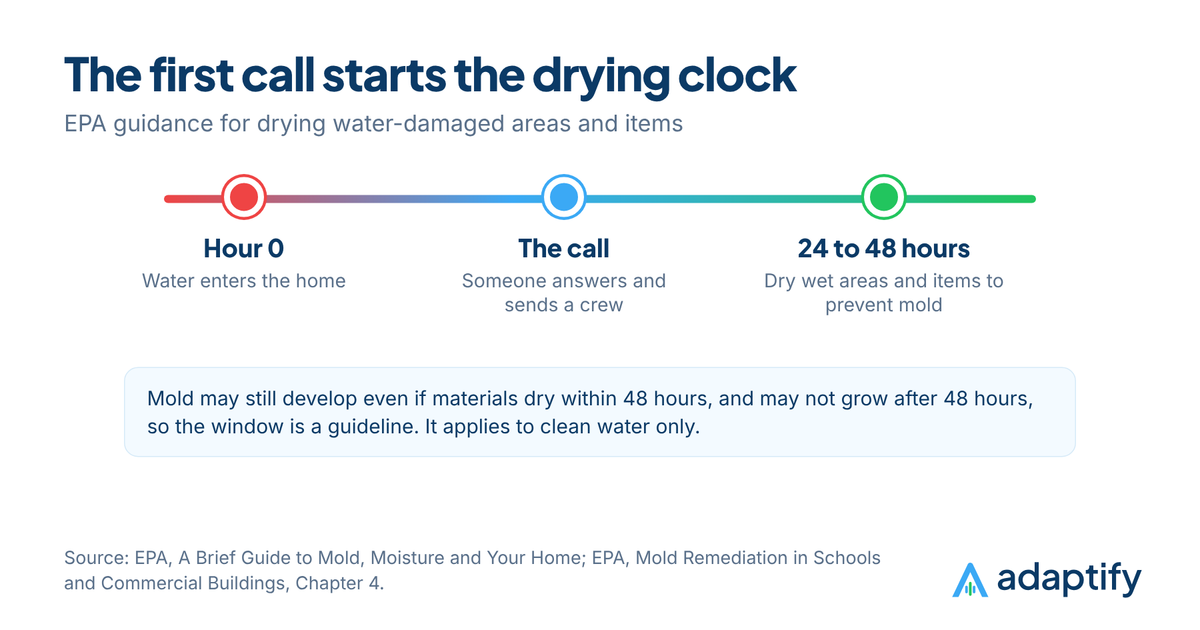
- The clock is running. The EPA says to dry water-damaged areas and items within 24 to 48 hours to prevent mold. Dried in that window, most materials will not grow mold. (EPA) The 24 to 48 hours is a guideline, not a guarantee, but it explains why callers push for the fastest response.
- The stakes are large. The Insurance Information Institute (Triple-I) reports that water damage and freezing made up 22.6% of homeowners insurance losses in 2023. The average claim from 2019 to 2023 was about $15,400. About 1.5 claims were filed per 100 insured homes each year. (Triple-I)
What you lose when restoration calls go unanswered
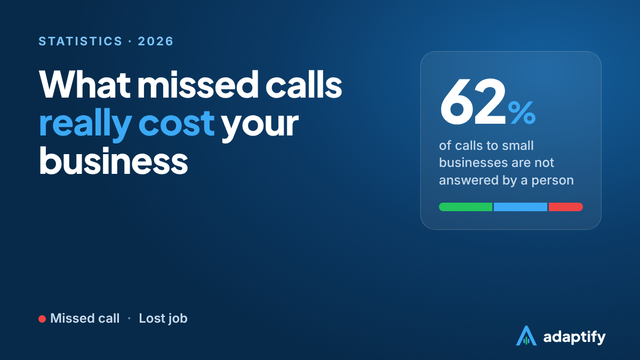
The call is rarely a second chance. Invoca reports that fewer than 3% of callers pushed to voicemail leave a message, and that 27% of calls to home services businesses go unanswered. (Invoca) In Invoca's 2026 benchmark of home services calls, which includes restoration, only 52% of inbound calls reached a person, with trades ranging from 32% to 74%. (Invoca 2026 report)
Customers also expect speed. Jobber's 2026 survey of 1,050 home service owners found that 28% of customers expect an immediate reply. Another 28% expect one within an hour. Only 20% of pros replied that fast. (Jobber) For a flooded kitchen, "within the hour" is generous.
What a water damage restoration answering service must do
A water damage restoration answering service that says "we will pass on your message" is not enough. A water damage call needs a calm, structured conversation.
1. Keep the caller safe first
The first thing a caller needs is not a quote. It is a few safe steps, delivered calmly. A good script covers:
- Stop the water if it is safe to do so, for example by closing the main shut-off valve.
- Stay away from standing water if outlets, appliances or panels may be involved. Shut off power only if the panel is dry and you can reach it safely.
- Avoid contact with sewage or contaminated water, and keep children and pets out.
- If anyone is in danger, call 911.
Write these steps with your own team, your insurer's guidance and local rules in mind, because the right advice depends on the situation.
2. Collect the right details
Your crew needs enough information to roll a truck and plan the job. Use this checklist for intake:
- Name, phone number and address: To reach the customer and dispatch the crew
- Source of the water: Supply line, appliance, roof leak, storm or sewage changes the response
- When it started and whether it is stopped: Sets urgency and how much water to expect
- Rooms and floors affected: Helps plan equipment and crew size
- Water type: clean, gray or contaminated: Drives safety and cost
- Insurance carrier and claim number: Speeds up the paperwork
- Who can give access: Avoids a wasted trip
3. Alert your on-call crew
The call should reach a human on your team in seconds, with the details above in one message. Set a backup contact for when the first person does not respond.
4. Log everything
Every call should leave a record: a summary, a recording or both. It protects you in insurance conversations and shows you which sources of leads are worth more.
Why water category matters to your answering service
Restoration sorts water into three categories, and your service should recognize them when it listens.
- Category 1, clean water: a broken supply line or an overflowing sink with clean water.
- Category 2, gray water: water from a dishwasher or washing machine, which may carry contaminants.
- Category 3, black water: sewage, rising floodwater and other seriously contaminated sources.
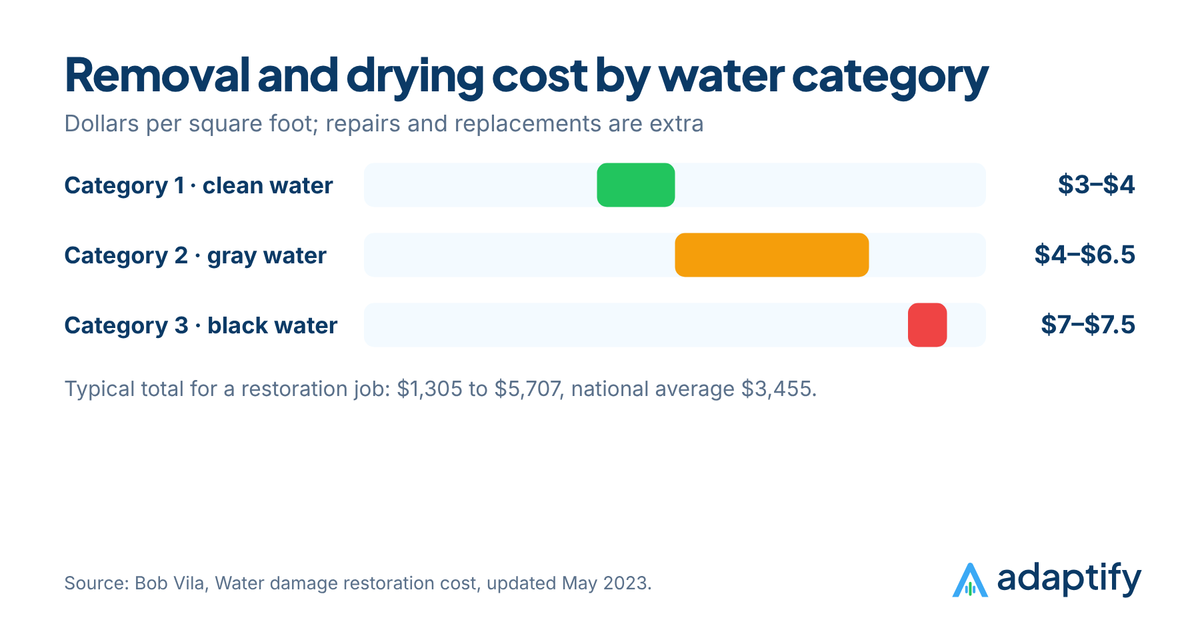
The category shapes the job and the cost. Bob Vila's cost guide (updated May 2023) puts the typical total for water damage restoration at $1,305 to $5,707. The national average is $3,455. For removal and drying alone, it lists about $3 to $4 per square foot for clean water. Gray water runs $4 to $6.50, and black water $7 to $7.50. Repairs and replacements cost extra. It also notes emergency fees of $50 to $200 at some companies. (Bob Vila)
For your phone line this means one thing: a caller who says "sewage" has a different job from a caller who says "kitchen supply line." The first minute of the call should sort them.
The EPA adds an important caveat. Its drying guidance applies to clean water. If water may be contaminated with sewage or chemicals, protective equipment and containment are required and an experienced professional should be consulted. (EPA)
Voicemail, staff, live operators or AI: how the options compare
Voicemail
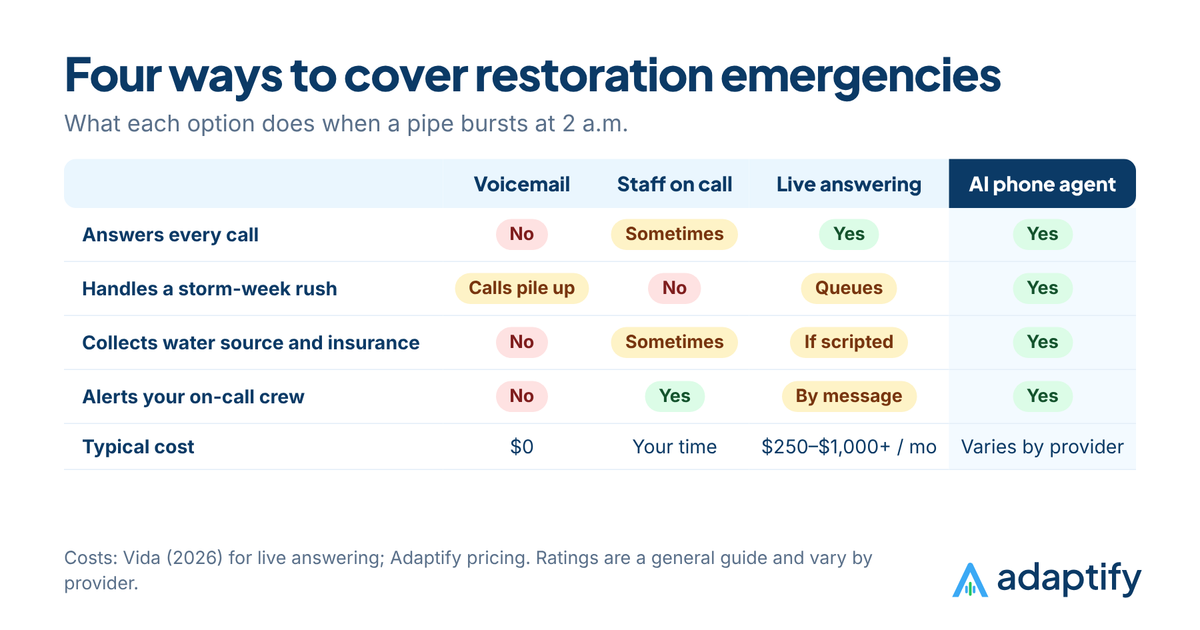
Free, and almost useless in an emergency. With fewer than 3% of callers leaving a message, voicemail records the jobs you lost.
Staff on call
Many restoration owners keep a phone on a rotation. It gives you control and a human voice, but it is hard on people. A tech on a job site cannot always pick up. Peak weeks, such as after a storm or a freeze, bring the most calls just when your team is busiest.
A live answering service
A human operator answers, reads your script and sends you a message or transfers the call. It works well when you need a friendly voice and reliable intake. Typical pricing from a 2026 guide by Vida (a vendor that sells AI, so read with care): $250 to $1,000+ a month, or about $0.65 to $1.75 a minute, or $1.75 to $4.00 per answered call. Extras can include weekend rates 10% to 25% higher, holiday rates 1.5 to 2 times normal, overage charges and script-change fees. Hidden charges can add 15% to 25% to advertised rates. (Vida)
The challenge for restoration is training. An operator who answers for dozens of businesses may not know your equipment or service area. They may not know clean water from gray water unless you invest in the script.
An AI phone agent
An AI phone agent answers instantly, follows a script built around your business and can take many calls at once. That matters after a storm or a cold snap, when 20 calls can arrive in an hour. It asks the intake questions, flags emergencies, alerts your crew and logs the call. Basic AI answering tools run about $25 to $200 a month, according to Vida. Done-for-you agents cost more because the agent is built and managed for you.
The trade-off: the quality depends on the setup. Choose a provider that tests the agent on your real call types. It should hand off to a human easily and tell callers they are speaking with an AI.
Water damage restoration answering service cost
An illustrative example for a restoration company with 80 after-hours calls a month at about 4 minutes each (320 minutes):
- Live answering at $1.75 to $4.00 per call: about $140 to $320 a month before extra fees and plan minimums.
- AI phone agent: pricing varies by provider. Most combine a setup fee, a monthly fee and a per-minute rate, so ask for all three and multiply by your real minutes.
At low volume a basic live service can be cheaper. The picture changes when you want triage, insurance details and crew alerts handled well. It also changes when a storm triples your call volume.
Now compare the cost of one lost job. The Bob Vila average for restoration is $3,455, and insurance claim averages are near $15,400. Saving a single job a month covers the service several times over.
Questions to ask a restoration call answering vendor
- Walk me through a burst pipe call and a sewage backup call. What is said, and what is asked?
- Who is alerted, how, and what happens if they do not respond?
- Can you capture insurance carrier and claim details?
- Can you tell the water category apart, or flag it for us to confirm?
- Do I get a summary or recording of every call?
- What does a busy week after a storm cost? List every fee.
- What is the contract length and cancellation policy?
- How do you tell callers they are speaking with an AI or an outsourced operator?
Ask for a test call to your own number and run a "burst pipe" scenario at 2 a.m.
How to set up 24/7 restoration call answering in a week
- Define emergencies. Decide what triggers an immediate crew alert, such as active flooding, sewage or a commercial property.
- Choose the on-call contact and a backup, with a response time target.
- Write the safety steps for callers with your team and insurer in mind.
- List the intake questions using the checklist above.
- Set your service area so the agent can politely decline jobs outside it.
- Forward your calls when the office is closed or busy.
- Test it with real scenarios.
- Review the first month of call summaries and adjust.
Adaptify: AI call answering for restoration companies
Adaptify builds, launches and manages an AI phone agent for your restoration company. The agent answers burst pipe, flood and sewage backup calls, alerts your on-call crew, takes insurance details and logs every call. It goes live in 6 days, and you do not set anything up yourself.
Want to see how this would work for your company? Check out the Adaptify water damage restoration page and the pricing page, or request your agent.
It is not the right choice for every company. If you take a few after-hours calls a month and only need a message, a basic live service may cost less. If you want every emergency answered, sorted and sent to your crew, an AI agent is built for that. There is no human script to maintain.
Common mistakes when you outsource restoration phone answering
- Relying on voicemail. Almost nobody leaves a message in an emergency.
- No safety steps. A caller standing in water needs guidance, not just a promise of a callback.
- No category triage. Treating sewage like a clean-water leak creates safety and cost problems.
- Forgetting the busy week. Check how the service performs when a storm brings 10 times the usual calls.
- Never testing. Call your own number at night every month.
Water damage restoration answering service checklist
- Write down what counts as an emergency for your company.
- List the intake details your crew needs.
- Decide who is alerted and the backup.
- Pick the option that fits your call volume and budget.
- Run a 2 a.m. test call before you commit.
Sources
Figures are reported by the organizations named. Some publishers also sell call-answering or call-tracking products, so we label vendor sources.
- EPA, A Brief Guide to Mold, Moisture and Your Home
- EPA, Mold Remediation in Schools and Commercial Buildings, Chapter 4
- Insurance Information Institute (Triple-I), Facts and statistics: homeowners and renters insurance (ISO data; excludes tenant and condominium policies, Alaska, Texas and Puerto Rico)
- Bob Vila, Water damage restoration cost (updated May 2023)
- Invoca, How much missed sales calls cost home services businesses (2024)
- Invoca, Home Services Lead Conversion Benchmarks Report 2026 (July 2026)
- Jobber, 2026 Home Service Trends Report (1,050 owners surveyed December 2025)
- Vida, Answering service pricing (February 2026; vendor-published ranges)
Frequently asked questions
What is a water damage restoration answering service?
It is a service that answers your calls 24/7, collects the details of the loss (water source, location, how long it has been happening, insurance carrier), and alerts your on-call crew or books the job. It can be a live operator or an AI phone agent.
Why do restoration companies need 24/7 call answering?
Water damage does not happen on a schedule, and the EPA advises drying wet areas and items within 24 to 48 hours to prevent mold. Callers are in an active emergency, so they call the next company if yours does not answer.
How much does a water damage restoration answering service cost?
A live operator typically costs $250 to $1,000+ a month, or about $0.65 to $1.75 a minute (Vida, 2026).
What information should the person answering collect on a water loss call?
The caller's name, phone number and address, the source of the water, when it started, whether it has been stopped, which rooms are affected, whether the water looks clean, gray or contaminated, the insurance carrier and claim number if they have one, and who can give access to the property.
Can an AI phone agent handle sewage backups and floods?
It can answer, ask the right questions, flag the call as an emergency and alert your crew. Calls involving sewage or contaminated water should be treated as urgent, and the agent should tell callers to avoid contact with the water.
Should an AI agent tell restoration callers it is an AI?
Yes. Being upfront builds trust, and an AI agent that hands emergencies to your crew quickly gives callers the human help they actually need.
How fast can I set up restoration call answering?
A live service can start in a day or two. Many providers launch a done-for-you agent within about a week.