On this page
- Why HVAC companies need AI customer service: the data
- What AI customer service for HVAC companies handles
- Top questions HVAC customers ask, and how AI customer service answers
- How AI customer service handles HVAC emergencies
- Sample call: AI customer service for an HVAC company at 8:40 p.m.
- AI customer service vs. an answering service for HVAC companies
- How much AI customer service costs for HVAC companies
- How to set up AI customer service for your HVAC company
- What to look for in AI customer service for HVAC companies
- Metrics to track with AI customer service for HVAC companies
- Mistakes to avoid with AI customer service for HVAC
- Is AI customer service right for your HVAC company?
- Adaptify: AI customer service built for HVAC companies
- Related guides
- Sources
AI customer service for HVAC companies is an AI phone agent that answers every customer call in your company's name, day or night. It books service and tune-ups, answers questions about fees and maintenance plans, and alerts your on-call tech when a home really can't wait.
Below: the numbers behind HVAC calls, what AI handles, how it deals with emergencies, a sample call, costs and setup.
Why HVAC companies need AI customer service: the data
- Calls peak after you close. The busiest window for residential HVAC calls is 5 to 9 p.m., and off-hours calls reach 14.1% of volume in June. (ServiceTitan)
- Customers want an answer now. 28% of home service customers expect an immediate reply and 28% expect one within an hour. Only 20% of pros reply that fast. (Jobber, 2026)
- Voicemail doesn't save the job. 27% of calls to home service businesses go unanswered, and fewer than 3% of callers sent to voicemail leave a message. (Invoca)
- Each call is worth real money. A typical AC repair costs $250 to $700, about $375 on average. (HomeServe, 2026)
Put together: the calls come when nobody is at the desk, the caller won't wait, and the next HVAC company is one tap away. More numbers in the cost of missed calls.
Want to hear it first? Play our HVAC demo call, or request your AI agent and be answering every HVAC call in 6 days.
What AI customer service for HVAC companies handles
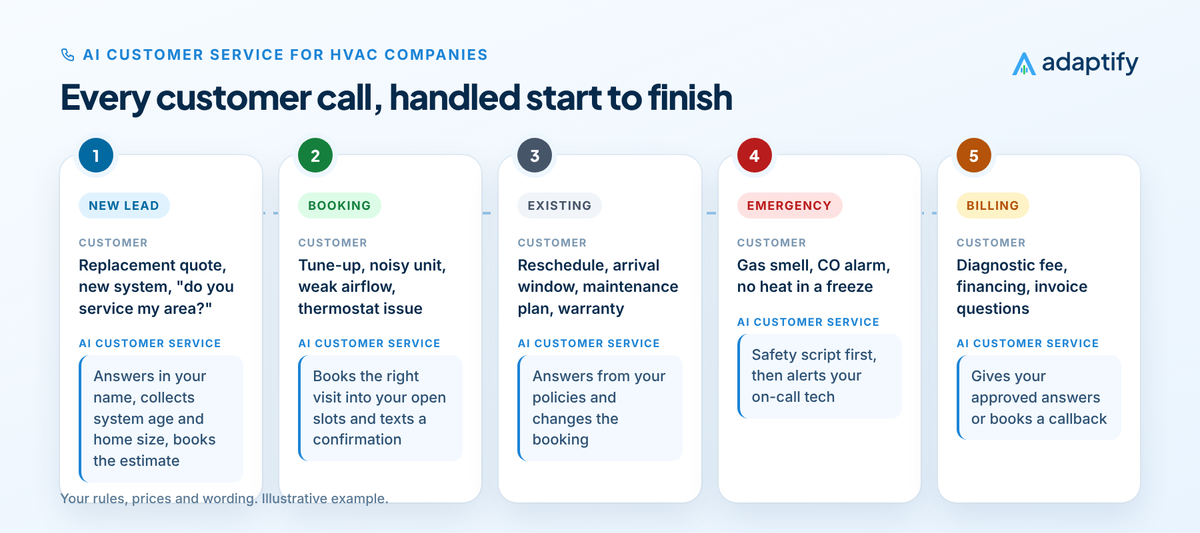
- New leads: replacement quotes, heat pumps, ductless, "do you service my area?" It collects system age, home size and symptoms, then books the estimate.
- Service calls: weak airflow, noises, leaks at the unit, thermostat problems. Booked into open slots with a text confirmation.
- Maintenance plan members: what the plan covers, priority booking and seasonal tune-ups.
- Existing customers: reschedules, arrival windows, parts status and warranty questions.
- Billing questions: diagnostic fees and financing, in your approved words, or a callback from the office.
Top questions HVAC customers ask, and how AI customer service answers
Most HVAC calls are the same dozen questions. These are the ones AI customer service answers best, using the wording you approve:
- "How soon can someone come out?" It checks your open slots and offers the first two, so the caller picks instead of waiting for a callback.
- "What's your diagnostic or service call fee?" It gives your exact fee and explains whether it's waived or credited if they go ahead with the repair.
- "Do you service my area?" It checks the address or ZIP against your service area and books, or politely declines.
- "Is my tune-up covered by my plan?" It explains what your maintenance plan includes and books the visit with member priority.
- "Should I repair or replace my system?" It collects system age, symptoms and repair history, then books a comfort advisor rather than guessing.
- "Do you offer financing?" It describes your financing options in your words and offers to book the estimate.
- "When will my tech arrive?" It confirms the booked window and, if your software allows, the current status, or routes to dispatch.
- "Is my system still under warranty?" It takes the model, install date and issue, then books a visit or a callback from your office.
How AI customer service handles HVAC emergencies
Emergencies get a fixed script that never skips a step, then go straight to a person:
- Gas smell or CO alarm: leave the home now, don't touch switches, and call 911 or the gas utility from outside, as utilities advise. (National Grid) Then your on-call tech is alerted.
- No cooling in a heat wave: the agent asks who is in the home. Adults 65 and older are more prone to heat-related illness, and a fan shouldn't be the main way to cool off in extreme heat. (CDC) Vulnerable households go to the front of the line by your rules.
- No heat in a freeze: triaged by outdoor temperature and household, then escalated or booked first thing.
Your tech gets a text and a call with a backup if they don't answer. See how emergency escalation works.
Sample call: AI customer service for an HVAC company at 8:40 p.m.
Caller: "You did our tune-up in April. The AC is running but the house won't go below 80."
AI agent: "Thanks for calling Coastal Air, I'm sorry it's so warm. As a Comfort Club member there's no diagnostic fee. Is anyone at home elderly, an infant or at risk in the heat?"
Caller: "No, just us."
AI agent: "Members get priority, so I can book you tomorrow from 8 to 10 a.m. Meanwhile, check the filter and that the thermostat is set to cool. Shall I book it?"
One call covered a plan question, triage, a booking and a text confirmation. Your plan names, fees and rules would be your own. Listen to our HVAC demo call.
AI customer service vs. an answering service for HVAC companies
- Voicemail: free, but fewer than 3% of callers leave a message. (Invoca)
- Live answering service: $250 to $1,000+ a month, with extra fees for weekends, holidays and transfers. Most take messages rather than book jobs. (Vida, 2026)
- AI customer service: answers every caller at once, books into your software, follows your triage rules exactly and costs a fraction per call.
Full comparison: HVAC answering service guide.
How much AI customer service costs for HVAC companies
How to set up AI customer service for your HVAC company
- List your top call types (your CSRs know them): bookings, plan questions, fees, reschedules, emergencies.
- Write your rules: what counts as an emergency, who's on call, which fees to quote.
- Pick when it answers: after hours, overflow or all day, and keep your business number.
- Connect your software: ServiceTitan, Jobber, Housecall Pro or your calendar. See how AI booking works.
- Test, go live and review the first week of recordings and transcripts. With Adaptify's done-for-you setup, you're live in 6 days.
What to look for in AI customer service for HVAC companies
Not every AI phone tool is built for HVAC. Before you choose one, check that it can:
- Run a safety script word for word on gas and CO calls, every time, before anything else.
- Triage by your rules, such as outdoor temperature, vulnerable household members and plan membership.
- Book into your software, not just take a message: ServiceTitan, Jobber, Housecall Pro or your calendar.
- Answer unlimited calls at once, because heat waves don't arrive one caller at a time.
- Give you recordings, transcripts and summaries for every call, so you can check quality and coach.
- Come set up for you. Self-serve tools leave the scripting and testing to you. A done-for-you AI receptionist is built and tuned by people who do it every day.
Metrics to track with AI customer service for HVAC companies
- Answer rate: the share of calls answered live. With AI it should be close to 100%, including evenings and weekends.
- Booking rate: how many service-request calls end with a booked visit.
- After-hours jobs: calls and bookings that came in after 5 p.m. or on weekends, which you'd have missed before.
- Escalations: how many calls went to your on-call tech, and whether each one truly needed it.
- Top call reasons: the questions customers ask most, which tell you what to add to your website or plan.
- Revenue from AI-booked jobs: match bookings to invoices in your software to see the real return.
Mistakes to avoid with AI customer service for HVAC
- Escalating everything. If every no-cool call wakes a tech, they'll burn out. Define what's urgent and let the rest book for the morning.
- Letting it quote replacements. Approve only fixed fees. System prices belong to your comfort advisor.
- Forgetting seasonal updates. Tune-up promos, plan pricing and slot availability change. Keep the agent current, or let Agent Maintenance do it.
- Never listening to calls. Skim a few transcripts a week. It's the fastest way to spot a confusing answer.
- Hiding that it's AI. Customers care about getting help fast. A friendly, honest agent that solves the problem builds more trust than one pretending to be a person.
Is AI customer service right for your HVAC company?
It's usually a strong fit if any of these sound familiar:
- Calls go to voicemail after 5 p.m. or on weekends.
- CSRs can't keep up during heat waves and cold snaps.
- Techs or owners answer the phone from job sites.
- You're paying an answering service that only takes messages.
- You sell maintenance plans and want members treated as priority.
If you already have a fully staffed 24/7 call center, AI still helps as overflow when every line is busy.
Adaptify: AI customer service built for HVAC companies
Adaptify builds, launches and manages AI customer service for HVAC companies: your safety script, heat and cold rules, plans, fees and software. Live in 6 days on your existing number, built on a voice platform that is HIPAA, SOC 2 and PCI DSS compliant. Rated 4.9/5 by our customers.
See the HVAC industry page, hear the HVAC demo or request your agent.
Related guides
- AI receptionist for HVAC companies
- After-hours answering service for HVAC
- AI customer service for plumbing companies
- AI customer service for electrical contractors
Sources
- ServiceTitan, HVAC summer after-hours call spike (2025 data, ServiceTitan customers)
- Jobber, Home Service Trends Report (2026, 1,050 owners)
- Invoca, the cost of missed calls for home services
- HomeServe, HVAC repair cost guide (2026)
- CDC, heat and older adults
- National Grid, report a gas emergency
- Vida, answering service pricing (2026; Vida sells AI answering)
Frequently asked questions
What is AI customer service for HVAC companies?
It is an AI phone agent that answers your customers' calls in your company's name, 24/7. It books service calls, tune-ups and replacement estimates, answers questions about fees, maintenance plans and arrival windows, reschedules visits and alerts your on-call tech for emergencies.
When do HVAC companies miss the most calls?
In the evening and in peak seasons. ServiceTitan's 2025 data on residential HVAC shops found the busiest window of the day was 5 to 9 p.m., and calls outside business hours reached 14.1% of volume in June.
How fast do HVAC customers expect an answer?
Fast. Jobber's 2026 survey found 28% of home service customers expect an immediate reply and another 28% expect one within an hour, while only 20% of pros reply that quickly.
Can AI customer service handle gas leaks and carbon monoxide calls?
Yes, with a safety script first. The caller is told to leave the home and call 911 or the gas utility from outside, and then your on-call tech is alerted. It never troubleshoots a gas or CO problem over the phone.
Does AI customer service work with ServiceTitan?
Yes, through a custom integration. Adaptify connects the agent to ServiceTitan, Jobber, Housecall Pro or your calendar so jobs land where your dispatchers already work.
What's the difference between AI customer service and an AI receptionist for HVAC?
An AI receptionist mainly answers and books new calls. AI customer service covers the whole relationship: new leads, plan members, reschedules, billing and warranty questions, and emergencies. Adaptify builds agents that do both.
Which metrics should HVAC companies track with AI customer service?
Answer rate, booking rate, after-hours jobs booked, escalations to your on-call tech, top call reasons and revenue from AI-booked jobs.
Will customers mind talking to AI?
Most callers care about fast, correct help. An agent that answers on the first ring, knows your fees and books a time solves the problem faster than voicemail or a hold queue.
How does it handle a heat wave?
It answers every call at once, so there is no hold queue. It follows your heat-wave rules, like prioritizing elderly or medically vulnerable households, and books or escalates calls accordingly.