On this page
- Why after-hours electrical calls matter
- What a missed after-hours call costs an electrician
- Electrical call triage: safety first
- Voicemail, on-call, live operators or AI: how the options compare
- Electrician answering service cost: a worked example
- Questions to ask any electrician answering vendor
- How to set up after-hours call answering for an electrical company
- Adaptify: AI call answering for electricians
- Common mistakes electricians make with after-hours calls
- Electrician answering service checklist
- Sources
An electrician answering service answers your phone when your office is closed or every electrician is on a job. It puts safety first, separates real emergencies from routine requests and gets the work to the right person. For electrical contractors, getting the first minute of the call right matters more than in almost any other trade. Some after-hours calls are a lost job if nobody answers. Others are a fire risk if somebody answers and says the wrong thing.
This guide compares the four ways to handle after-hours electrical calls: voicemail, an on-call rotation, a live answering service and an AI phone agent. It covers what each costs, a safety-first triage table and a checklist for choosing. Sources are linked at the end.
Why after-hours electrical calls matter
People notice electrical problems when they are home: in the evening, at night and on weekends. Half the house goes dark at 8 p.m., a breaker trips every time the dryer runs, an outlet smells hot before bed. A business loses power to its freezers on a Sunday. These callers want someone who answers, sounds competent and gives them a next step.
The stakes are real. In its Home Electrical Fires report, NFPA estimated that US fire departments responded to an average of 31,960 home structure fires a year involving electrical distribution or lighting equipment from 2010 to 2014. Those fires caused about 400 civilian deaths, 1,180 injuries and $1.2 billion in direct property damage each year. (NFPA, Home Electrical Fires)
Most after-hours calls are not fires. But every person answering your phone needs to know how to spot the ones that might be.
Missed calls are common in the trades:
- 52% of inbound calls to home services businesses reached a person in Invoca's 2026 benchmark, with a range of 32% to 74% across trades. (Invoca 2026 report)
- Fewer than 3% of callers pushed to voicemail leave a message. (Invoca)
- 28% of customers expect an immediate reply and another 28% expect one within an hour, while only 20% of home service pros reply that fast. (Jobber 2026 report)
What a missed after-hours call costs an electrician
After-hours electrical work pays more. Housecall Pro's 2026 pricing guide for electrical contractors puts a typical service call fee at $100 to $200, billed separately from labor. It says nights, weekends and holidays usually add another $100 to $200 on top of standard rates. (Housecall Pro)
Then there is the work that follows. A homeowner whose panel failed at night may need a panel upgrade. A tripping breaker can turn into a dedicated circuit, an EV charger or a rewire quote. A commercial client whose cooler lost power on a weekend often becomes a maintenance account. The emergency is the first job, not the only one.
To estimate your own gap, use the missed call calculator or read our breakdown of the cost of missed calls.
Electrical call triage: safety first
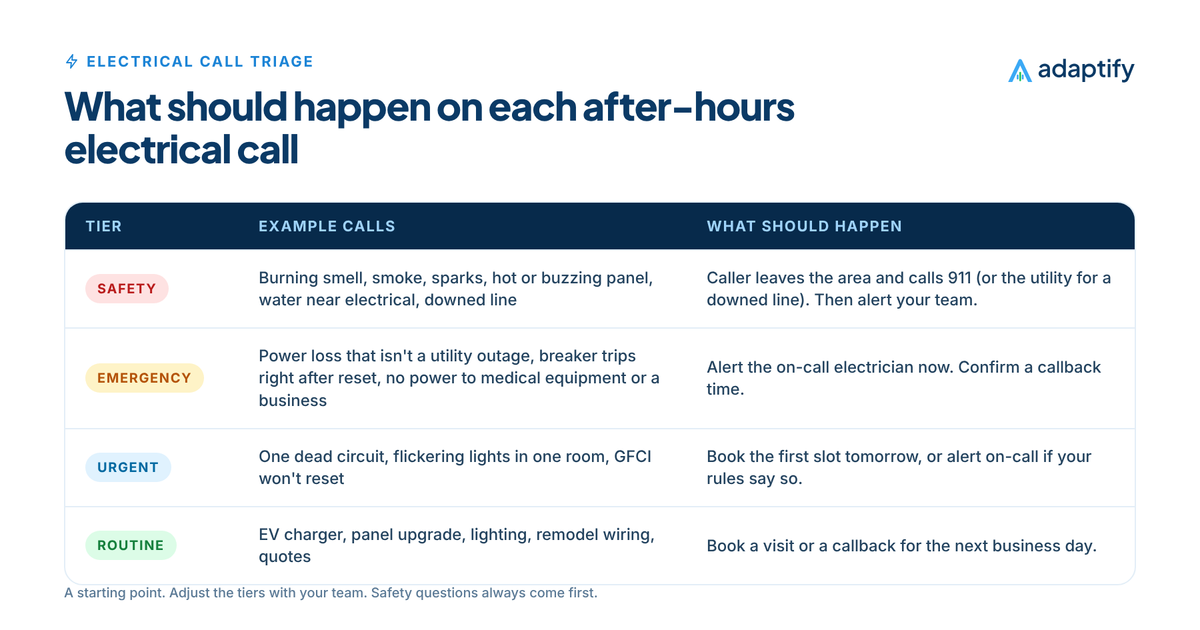
Before you choose how calls get answered, decide what should happen on each type of call. Write it down. Every answering option, human or AI, needs these rules. Use this as a starting point and adjust it with your own team:
- Safety — Example: Burning smell, smoke, sparks, a hot or buzzing panel, water near electrical, a downed power line — What should happen: Tell the caller to leave the area and call 911, or the utility for a downed line. Then alert your team
- Emergency — Example: Loss of power to all or part of the home that isn't a utility outage, a breaker that trips again right after reset, no power to medical equipment, freezers or a business — What should happen: Alert the on-call electrician now and confirm a callback time
- Urgent — Example: One dead circuit, flickering lights in one room, a GFCI that won't reset, a dead outlet — What should happen: Book the first slot tomorrow or alert on-call if your rules say so
- Routine — Example: EV charger, panel upgrade, lighting install, remodel wiring, quotes — What should happen: Book a visit or a callback for the next business day
The first question on every electrical call
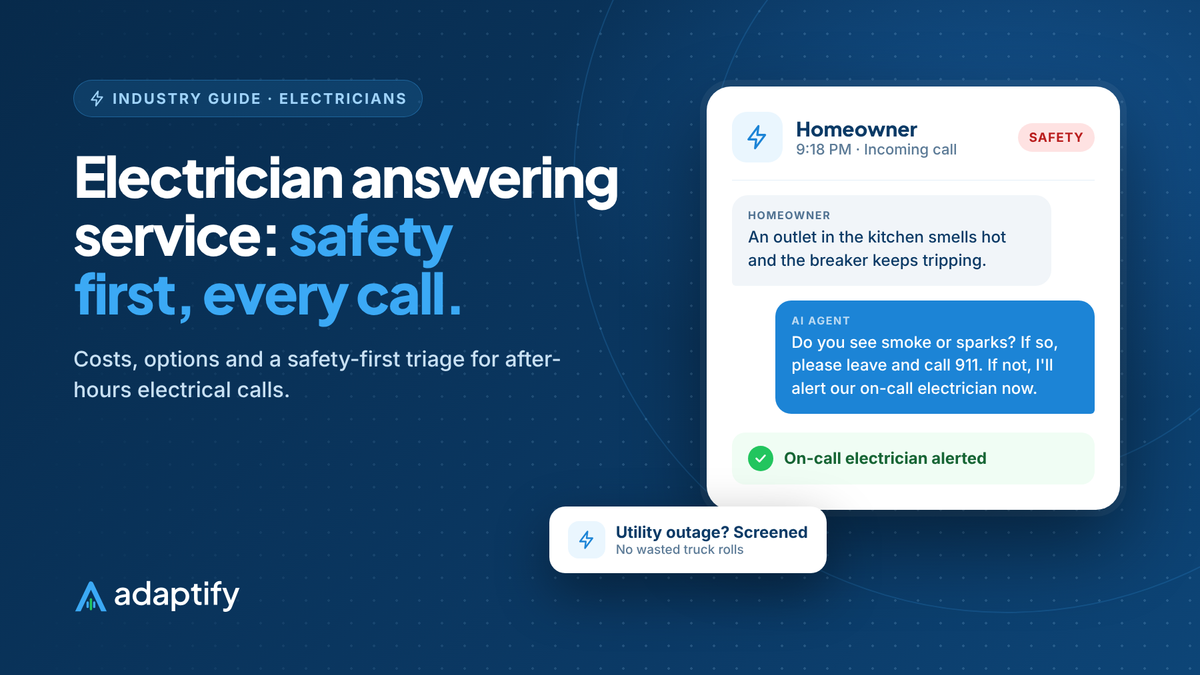
Before anything else, the person or system answering should ask: "Do you see smoke or sparks, or smell burning or anything hot?" If the answer is yes, the next sentence is "Please leave the area and call 911." Fire safety guidance is consistent on this. The Electrical Safety Foundation International teaches homeowners to treat a burning smell, sparks or a hot outlet or panel as a warning sign of an electrical fire hazard.
Only after the safety question should the call move to details: name, address, callback number, what is happening and how long it has been going on.
Is it your job or the utility's?
A lot of after-hours "no power" calls are utility outages. A few simple questions sort them out:
- Are your neighbors' lights out too?
- Is all of your power out, or only some rooms?
- Did you check the main breaker and any tripped breakers?
If the whole street is dark, the caller should report it to their utility and you have saved everyone a truck roll. If only part of the home is out, or a breaker won't stay on, it is likely your job.
Voicemail, on-call, live operators or AI: how the options compare
1. Voicemail
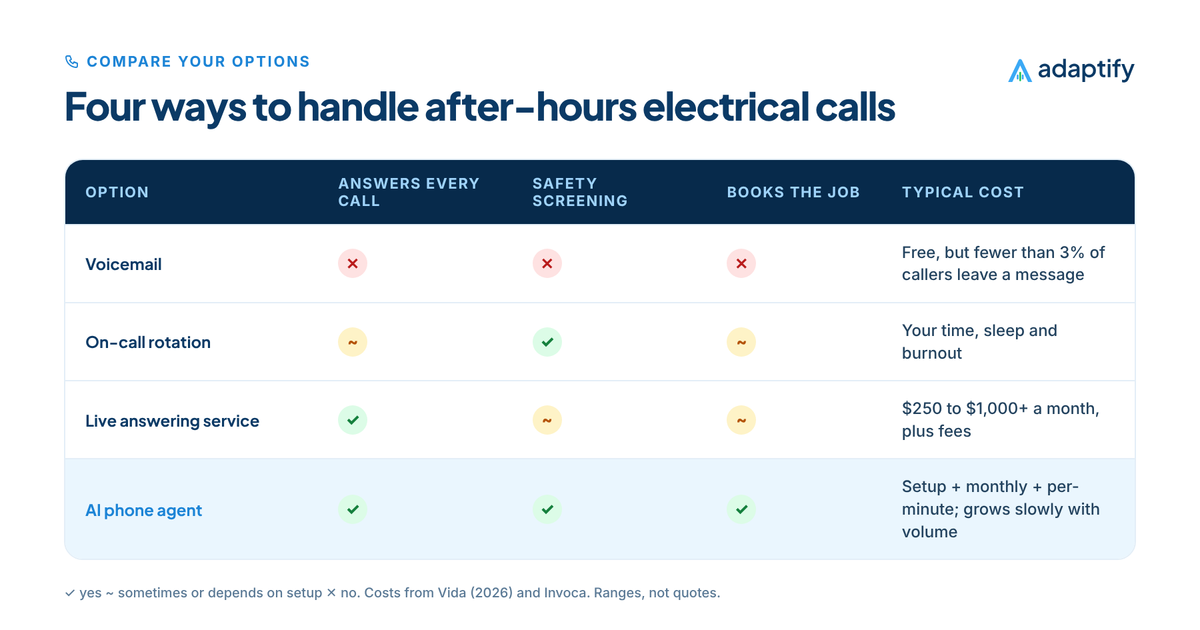
Free, and unsafe as an emergency plan. With fewer than 3% of callers leaving a message, most after-hours jobs go to the next electrician on the list. Worse, a caller with a hot panel gets no safety instruction at all.
2. An on-call rotation
Many shops forward the line to the owner or rotate it among electricians. You keep full control, and an electrician on the phone can judge risk well. The problems are coverage and fatigue. The on-call electrician is often working, driving or asleep, and when they are on one emergency, the next caller hits voicemail.
3. A live answering service
A human operator answers in your company's name, follows your script and sends the message or transfers the call. It is a fair option if you mainly need messages taken and you have a clear safety script for operators to read.
Vida's 2026 pricing guide puts live answering at $250 to $1,000+ a month, or about $0.65 to $1.75 a minute or $1.75 to $4.00 per call. It also flags extra charges for weekends, holidays, transfers, script changes and overages. Vida sells AI answering, so weigh that. (Vida)
The trade-off: general operators handle calls for many industries and may not know a tripped GFCI from a failing main breaker. Many take messages instead of booking work.
4. An AI phone agent
An AI phone agent answers on the first ring and runs your safety question on every single call, the same way every time. It can sort utility outages from real jobs, alert your on-call electrician with the address and the problem, and book routine work like EV charger quotes into your calendar. It handles many calls at once, so a storm that knocks out half the area doesn't create a queue.
Basic AI tools start around $25 to $200 a month, according to the same Vida guide. Done-for-you agents cost more because someone builds, tests and manages the agent around your business. Look for one that is tested on real electrical calls, transfers to a person easily and tells callers it is an AI.
Electrician answering service cost: a worked example
An illustrative example. Your numbers will differ.
- Volume: 60 after-hours calls a month, averaging 3 minutes each (180 minutes).
- Live answering at $1.75 to $4.00 per call: about $105 to $240 a month, before weekend, holiday and overage fees.
- AI phone agent: usually a setup fee, a monthly fee and a per-minute rate. Ask for all three and run your busiest storm month through the math.
At low volume, a basic message service can cost less. The math changes when you want emergencies screened for safety, utility outages filtered out and routine jobs booked, not just messages passed along. One after-hours service call with a $100 to $200 trip fee plus the night premium usually covers a month.
Questions to ask any electrician answering vendor
- What is the first thing you say when a caller smells burning? Show me the script.
- How do you handle a downed power line or water near a panel?
- How do you tell a utility outage from a job for us?
- Who gets alerted, how, and what happens if my on-call electrician doesn't answer in 10 minutes?
- Can you book into my calendar or field service software?
- Where do I see recordings or transcripts?
- What does a storm week with triple the calls cost? List every fee.
- How are callers told they are speaking with an AI or an outside operator?
Then call your own line at night and say your panel is buzzing. Listen to what happens.
How to set up after-hours call answering for an electrical company
- Define your hours, including weekends and holidays.
- Write your safety script. The burning, smoke, sparks and heat question goes first.
- Write your triage rules using the table above.
- Name the on-call electrician and a backup, with response times.
- Add the utility outage questions so you don't roll a truck for a neighborhood outage.
- Set booking rules for routine work and quotes.
- Forward your business line after hours or on no answer, so you keep your number.
- Test every path, then review calls weekly for the first month.
Adaptify: AI call answering for electricians
Adaptify builds, launches and manages an AI phone agent for your electrical company, so there is nothing for you to set up. The agent asks the safety question on every call, sorts utility outages from real jobs, alerts your on-call electrician about emergencies, books routine work and logs every call with a recording and transcript. It goes live in 6 days and you can keep your number.
See the industries page, check pricing or request your agent.
If you get only a few after-hours calls a month and only need messages, a basic live service may cost less. If you are losing real jobs to unanswered calls, an AI agent is built for that.
Common mistakes electricians make with after-hours calls
- Treating voicemail as a plan. It loses most callers and gives no safety instruction.
- Taking a message before asking the safety question.
- Rolling a truck for a utility outage.
- Letting the on-call electrician answer calls while they are working live.
- Choosing a service on monthly price alone, then losing one big job a month.
- Never testing your own line at night.
Electrician answering service checklist
- Count last month's missed calls and when they came in.
- Multiply by your average service call and your booking rate.
- Write your safety script and triage rules.
- Pick the option that delivers what you need: a message, a dispatched electrician or a booked job.
- Run a night test call before you sign.
Sources
Figures are reported by the organizations named. Several publishers sell call-answering, call-tracking or field service software, so we note vendor sources and don't treat their estimates as independent measurements.
- NFPA, Home Electrical Fires (March 2017; 2010 to 2014 data)
- Electrical Safety Foundation International (ESFI)
- Housecall Pro, How to price electrical work (2026; contractor pricing guide)
- Invoca, Home Services Lead Conversion Benchmarks Report 2026 (July 2026)
- Invoca, How much missed sales calls cost home services businesses (2024)
- Jobber, 2026 Home Service Trends Report
- Vida, Answering service pricing (February 2026; vendor-published ranges)
Frequently asked questions
What is an electrician answering service?
It answers your business phone when you can't, usually nights, weekends and while your electricians are on jobs. It screens for safety risks, collects the caller's details, alerts your on-call electrician for emergencies and books routine work.
How much does an answering service for electricians cost?
Live operator services typically cost $250 to $1,000+ a month, or about $0.65 to $1.75 a minute, before extra fees (Vida, 2026). AI phone agents range from basic tools at $25 to $200 a month to done-for-you agents priced with a setup fee, a monthly fee and per-minute usage.
What counts as an electrical emergency after hours?
A burning smell, smoke, sparks, a hot or buzzing panel, water near electrical equipment and a downed power line are safety emergencies, and the caller should call 911 or the utility first. A full or partial loss of power that isn't a utility outage, a breaker that keeps tripping and no power to critical equipment are usually on-call emergencies.
What should an answering service tell a caller who smells burning?
To leave the area and call 911 if there is smoke, sparks, heat or a burning smell, and not to touch the panel if it is hot or wet. Only after that should it take details for your team.
Can an answering service tell if a power outage is the utility's problem?
It can ask simple questions: are the neighbors out too, are any lights on, did a breaker trip. If the whole street is dark, the caller should report it to their utility. If only their home or part of it is out, it may be a job for you.
Is an AI answering service safe for electricians?
It can be, if it is built with a safety script that always comes first and is tested on real electrical calls. AI follows the same script on every call, answers instantly and can alert your on-call electrician within seconds. It should tell callers it is an AI and transfer to a person when needed.