On this page
- Why restoration companies need AI customer service: the data
- What AI customer service for water damage restoration companies handles
- How AI customer service handles water damage emergencies
- Clean, gray or black water: how restoration AI customer service sorts the loss
- Sample call: AI customer service for a restoration company at 2:13 a.m.
- AI customer service vs. an answering service for restoration companies
- How much AI customer service costs for restoration companies
- How to set up AI customer service for your restoration company
- First-call intake checklist for water damage restoration
- Top questions restoration customers ask, answered by AI
- Restoration KPIs to track with AI customer service
- Adaptify: AI customer service built for restoration companies
- Related guides
- Sources
AI customer service for water damage restoration companies is an AI phone agent that answers every loss call in your company's name, calms the caller, collects the details your crew needs, alerts your on-call team right away and keeps customers informed through drying and rebuild.
Below: the numbers behind restoration calls, what AI handles, a 2 a.m. sample call, costs and setup.
Why restoration companies need AI customer service: the data
- The clock starts on the first call. The EPA advises drying water-damaged areas and items within 24 to 48 hours to prevent mold growth. (EPA)
- Each loss is a big job. Water damage restoration typically costs $1,305 to $5,707, with a national average of $3,455, before rebuild. (Bob Vila)
- Many calls never reach a person. In Invoca's 2026 home services benchmark, which includes restoration, only 52% of inbound calls reached a person, ranging from 32% to 74% by trade. (Invoca)
- No second chance. Fewer than 3% of callers pushed to voicemail leave a message. (Invoca) A homeowner in standing water calls the next company.
Win the 2 a.m. loss. Play our water damage restoration demo or request your restoration AI agent, live in 6 days.
What AI customer service for water damage restoration companies handles
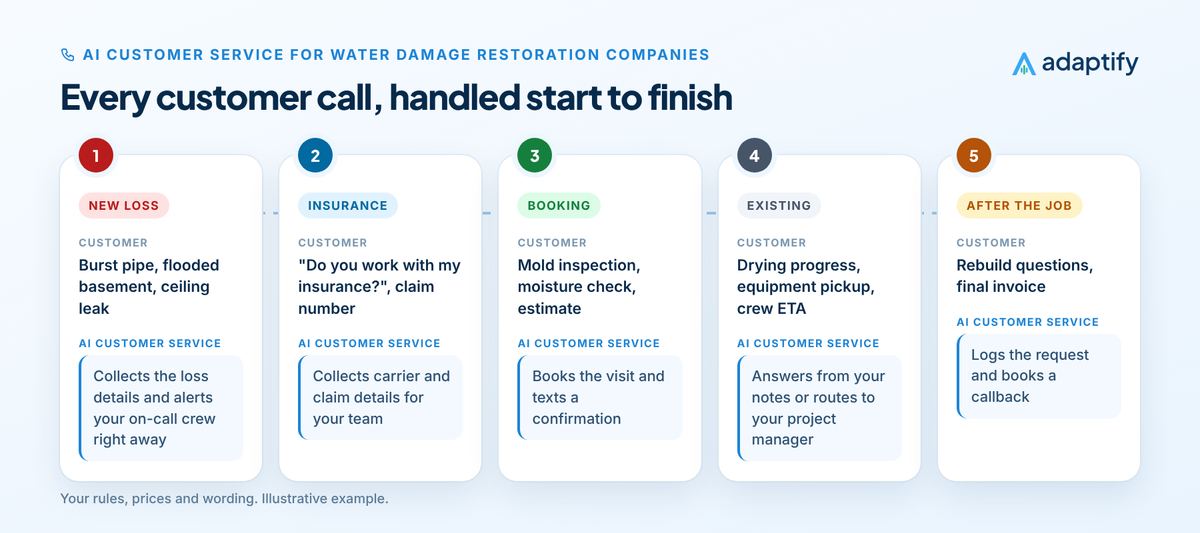
- New losses: burst pipes, flooded basements, ceiling leaks, appliance failures. Source, rooms, time wet and address collected, crew alerted.
- Insurance questions: carrier, claim number and adjuster status collected for your team.
- Inspections: mold checks, moisture readings, estimates, booked with a text confirmation.
- Active jobs: drying progress, equipment noise or pickup, crew arrival times.
- Rebuild and billing: rebuild schedule, deductible questions, final invoice, logged with a callback.
How AI customer service handles water damage emergencies
- Stop the water if safe: main shut-off or the appliance valve.
- Stay safe: keep out of standing water near outlets or electrical equipment.
- Flag contaminated water: sewage or chemicals need protective equipment and a professional. (EPA) The agent asks about the source so your crew comes prepared.
- Dispatch: your crew lead gets a text and a call, with a backup. See emergency escalation.
Clean, gray or black water: how restoration AI customer service sorts the loss
The water source changes the crew, the equipment and the price. Bob Vila's cost guide puts removal and drying at roughly $3 to $4 per square foot for clean water, $4 to $6.50 for gray water and $7 to $7.50 for black water, with emergency fees of $50 to $200 at some companies. (Bob Vila) So the agent asks the right questions up front:
- Clean water: supply line, water heater, burst pipe, rain. Standard drying crew.
- Gray water: dishwasher, washing machine, toilet overflow without waste. Flagged so your crew brings protection.
- Black water: sewage backup, outside flooding, standing water over days. The caller is told to stay out of it, and your crew gets a contamination alert.
That one question means the right truck rolls the first time, and your estimate starts with accurate scope.
Sample call: AI customer service for a restoration company at 2:13 a.m.
Caller: "My basement is flooding. There's two inches of water down there."
AI agent: "I'm so sorry, we'll help right now. This is ProDry Restoration. Is the water still coming in, and do you know where from?"
Caller: "I think the water heater. It's still leaking."
AI agent: "If you can safely reach it, close the cold water valve on top of the heater, and stay out of water near outlets. What's your address? I'm alerting our on-call crew now."
The crew lead gets the address, source, depth and that the leak is active. Hear our water damage restoration demo call.
AI customer service vs. an answering service for restoration companies
- Voicemail: loses the loss. Almost nobody in an emergency leaves a message.
- Live answering service: $250 to $1,000+ a month, with holiday rates up to 2x and hidden fees adding 15% to 25%. (Vida, 2026)
- AI customer service: answers on the first ring, every time, takes full intake and dispatches your crew in seconds.
Full comparison: water damage restoration answering service guide.
How much AI customer service costs for restoration companies
How to set up AI customer service for your restoration company
- Write your intake questions: source, category of water, rooms, time wet, insurance.
- Set dispatch rules: who's on call, backups, what triggers an instant alert.
- Share your active-job process: where notes live and who owns each job.
- Use the call records: recordings and transcripts help with documentation and adjuster conversations.
- Go live 24/7 and keep your business number. With Adaptify's done-for-you setup, you're live in 6 days.
First-call intake checklist for water damage restoration
A complete intake on the first call saves a callback and starts your file. AI customer service collects:
- Address, caller name and whether they own or rent.
- Source of the water and whether it's still flowing.
- When it started, which tells you how close you are to the 24 to 48 hour mold window.
- Rooms and materials affected: carpet, drywall, hardwood, ceilings.
- Power status and any water near electrical.
- Insurance carrier, policy holder and claim number if filed.
- For renters and tenants: the landlord or property manager's contact.
Top questions restoration customers ask, answered by AI
- "How fast can you get here?" Your response time, with the crew already alerted.
- "Will my insurance pay for this?" How you work with insurers and what to have ready, without coverage promises.
- "What should I do until you arrive?" Stop the source if safe, stay clear of electrical, move valuables, take photos.
- "How long will the drying take?" Your typical timeline, with updates from your project notes.
- "Can you turn the fans off at night?" Your equipment policy, and a note to the project manager.
- "Do you do mold remediation and rebuild too?" Your full service list, then the next appointment booked.
Restoration KPIs to track with AI customer service
- Speed to dispatch: minutes from first ring to crew alert.
- Losses captured after hours: the jobs that used to go to whoever answered first.
- Complete intakes: files with source, category and insurance details on the first call.
- Mitigation to rebuild conversion: customers who stay with you because they always reached someone.
Adaptify: AI customer service built for restoration companies
Adaptify builds, launches and manages AI customer service for water damage restoration companies: your intake questions, dispatch rules, insurance wording and active-job answers. Live in 6 days on your existing number, built on a voice platform that is HIPAA, SOC 2 and PCI DSS compliant. Rated 4.9/5 by our customers.
See the water damage restoration industry page, hear the restoration demo or request your agent.
Related guides
- AI receptionist for restoration companies
- 24/7 answering service for water damage restoration
- AI customer service for plumbing companies
- AI customer service for roofing companies
Sources
Frequently asked questions
What is AI customer service for water damage restoration companies?
It is an AI phone agent that answers your calls in your company's name, 24/7. It takes loss details, gives basic safety steps, alerts your on-call crew for active water, collects insurance information, books inspections and answers customers' questions about drying, equipment and rebuild.
Why does speed matter so much in restoration?
The EPA advises drying water-damaged areas and items within 24 to 48 hours to prevent mold growth. A homeowner standing in water calls until someone answers, and the first company to answer usually gets the job.
What is a water damage call worth?
Bob Vila's cost guide puts typical water damage restoration at $1,305 to $5,707, with a national average of $3,455, before repairs and rebuild.
Does it handle insurance questions?
It collects the carrier, policy holder and claim number, and can explain how you work with insurance in your approved words. It does not give coverage advice.
Does it ask about clean, gray or black water?
Yes. It asks where the water came from and sorts it into your categories, so your crew brings the right protection and equipment and the estimate starts with accurate scope.
What does AI customer service collect on a water damage call?
Address, owner or renter, water source, whether it's still flowing, when it started, rooms and materials affected, power status, insurance details and landlord contact if needed.
Can it answer questions during the drying process?
Yes. It answers drying timeline, equipment and crew arrival questions from your notes, or logs the request for your project manager.
Can it handle a regional storm or freeze?
Yes. It answers every caller at once, so a freeze night with dozens of burst-pipe calls doesn't create a hold queue.